



Traders frequently confuse a simple pullback with a major market reversal. As a result, they enter positions prematurely and suffer unnecessary stop-outs. You can eliminate this common structural friction by properly contrasting continuous momentum against structural failure. This comprehensive guide details the precise mechanical differences, psychological drivers, and intermediate trading strategies required to trade these advanced structural concepts accurately.
| Feature | Break of Structure (BOS) | Change of Character (CHOCH) |
|---|---|---|
| Market Phase | Trend Continuation | Potential Trend Reversal / Shift |
| Location on Chart | Typically occurs mid-trend as price expands | Optimally occurs at Major HTF Supply/Demand Zones or Order Blocks |
| Risk Profile | Lower risk (follows established momentum) | Higher risk (catches falling knife) but offers higher RR ratio |
| Confirmation Requirements | Requires a simple continuation of the established cycle | Requires the failure of a structural pivot point (strong high/low) |
Understanding Market Structure: The Foundation of Break of Structure vs Change of Character
You must properly define basic market structure before you can map advanced order flow transitions. Market structure maps the exact path of institutional liquidity through a series of easily identifiable swing points. Therefore, learning to read these swings gives you a distinct edge in spotting future price expansions.
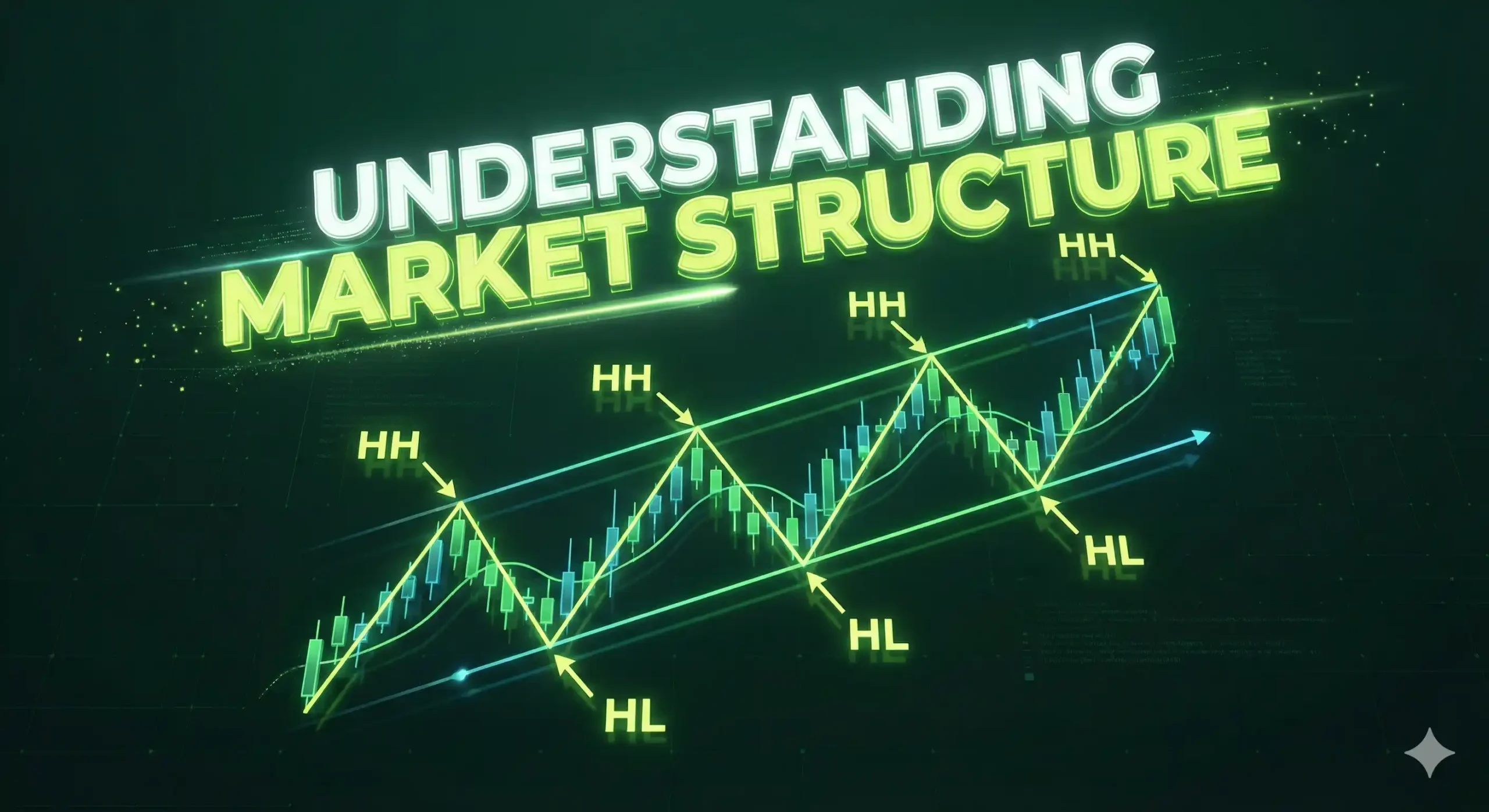
Defining Market Structure Trends Before a Break of Structure (BOS)
The foundational concepts of market structure originate from Dow Theory. Charles Dow formulated this theory in the late 19th century to track primary market trends. Dow Theory strictly states that a primary uptrend features a continuous sequence of ascending peaks and troughs. Conversely, a primary downtrend features a sequence of descending peaks and troughs.
Traders define an active bullish trend by identifying consecutive Higher Highs (HH) and Higher Lows (HL). Similarly, they define a bearish trend by marking consecutive Lower Highs (LH) and Lower Lows (LL). Modern Smart Money Concepts (SMC) dictate that a trend remains structurally intact until price breaches a defining high or low. Therefore, these pre-existing structural points serve as the essential prerequisites for identifying any valid continuation signal.
What Is an Order Block in Trading? A Step-by-Step Identification Guide 2026
How a Change of Character (CHOCH) Shifts Market Structure
A structural shift fundamentally alters the established supply and demand dynamic on the price chart. The specific term Change of Character originates from the Wyckoff Method, which Richard Wyckoff developed in the early 20th century. Wyckoff specifically used this terminology to describe the volatile transition between accumulation and mark-up phases.
In modern SMC terminology, a Change of Character represents the absolute first internal structural break signaling a potential trend reversal. This shift occurs when an active uptrend finally breaks below a Higher Low, or when a downtrend successfully breaks above a Lower High. Consequently, this precise fracture in market structure serves as the earliest reliable indication that the ruling market participants have lost control.
Deep Dive: What is a Break of Structure (BOS)?
A Break of Structure (BOS) simply represents the successful continuation of an established market trend. The market validates a BOS when price aggressively moves in the direction of the dominant trend and breaks past the previous structural extreme. Furthermore, trading alongside a confirmed BOS aligns with the classic trading axiom, “The trend is your friend until it bends.”
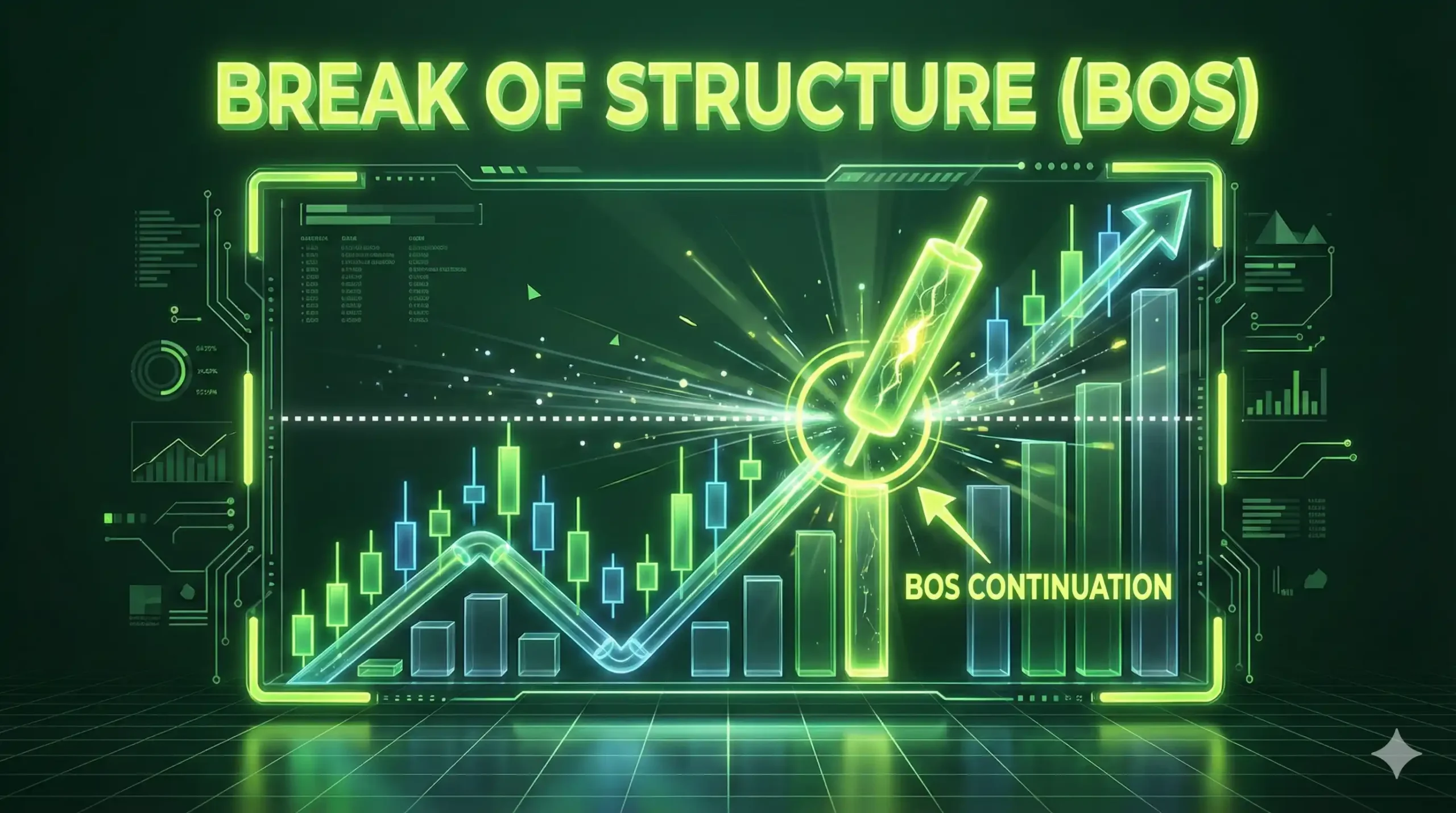
Analyzing Bullish Break of Structure (BOS) Examples
A bullish BOS materializes when market price breaks and officially closes above a preceding Higher High. This technical event confirms that an ongoing uptrend remains highly active and structurally sound. Furthermore, it explicitly shows that buyers maintain absolute control over the market order flow.
From a psychological perspective, a bullish BOS confirms that buyers are aggressively absorbing all available supply. Institutional algorithms continue pushing momentum upward because demand heavily outweighs available sell orders. Therefore, when you spot a bullish BOS, you should primarily look for long entry opportunities during the subsequent structural pullbacks.
Analyzing Bearish Break of Structure (BOS) Examples
Conversely, a bearish BOS occurs when price forcibly breaks and closes below a preceding Lower Low. This crucial price action confirms the ongoing continuation of a determined downtrend. According to technical analysis literature on trend continuity, established trends hold a statistically higher probability of continuing via a BOS than reversing completely.
When a bearish BOS prints on your chart, it confirms that sellers are completely overwhelming market demand. Sellers eagerly dump positions, establishing continuous downside momentum that breaks through older structural support levels. Consequently, you must prioritize short-selling strategies until the market prints a valid reversal signal.
Deep Dive: What is a Change of Character (CHOCH)?
Unlike a continuation signal, a Change of Character (CHOCH) highlights a sudden fracture in the existing market sequence. This specific pattern strictly highlights the initial failure of a trend to maintain its established trajectory. However, traders must remember a vital cautionary fact: a CHOCH acts as an early indication, not a fully confirmed reversal.
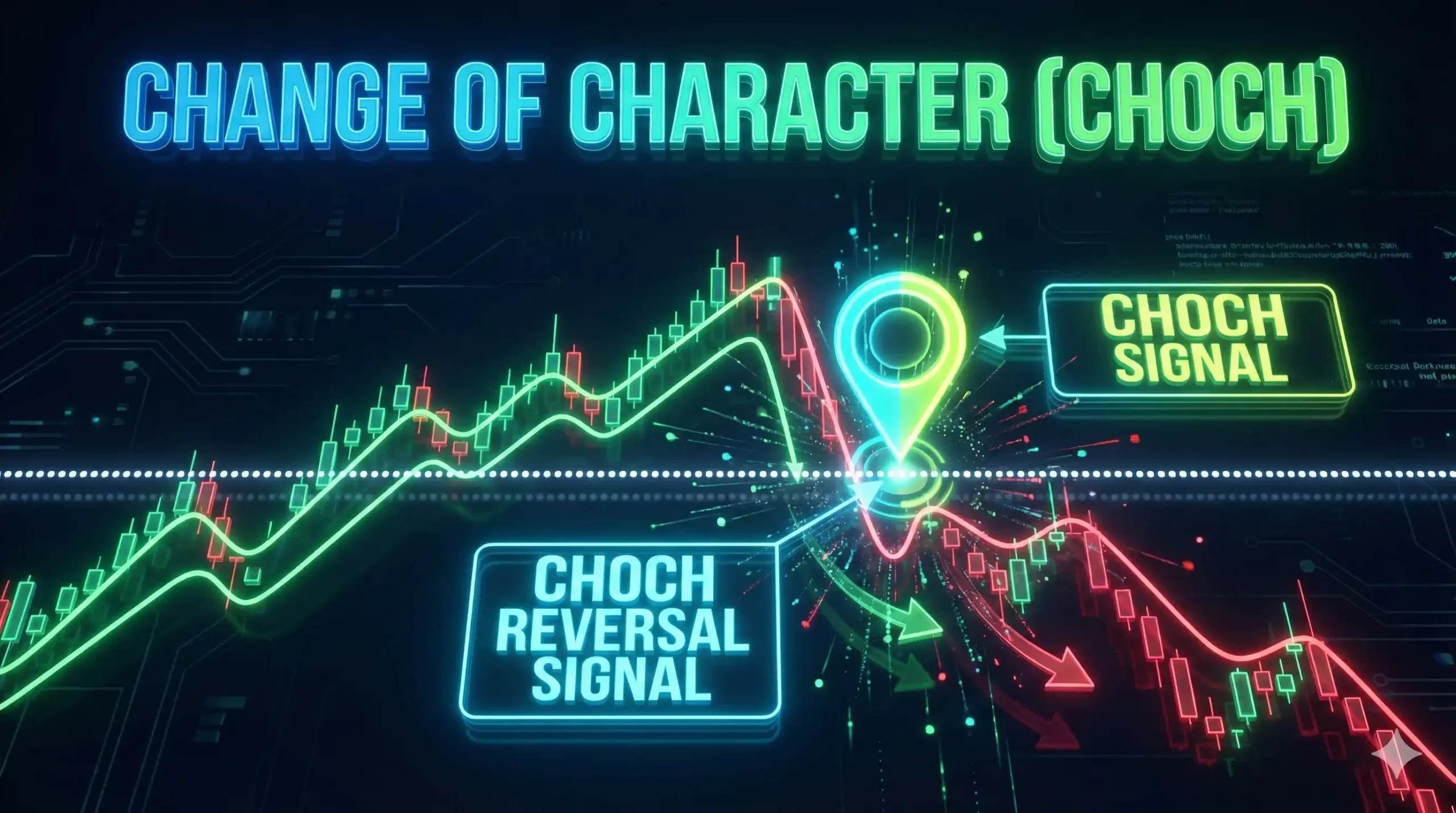
Analyzing Bullish Change of Character (CHOCH) Examples
A bullish CHOCH strictly occurs at the absolute tail-end of an established downtrend. The previous continuous sequence of Lower Lows and Lower Highs finally halts. Subsequently, the market price pushes up and breaks above the most recent Lower High, shattering the bearish structural integrity.
This specific break signals that the dominant supply side has completely exhausted its selling pressure. Buyers suddenly step in and willingly pay higher prices, thus shifting the immediate order flow. Therefore, this bullish structural failure provides your first actionable clue that a new upward trend might begin shortly.
Analyzing Bearish Change of Character (CHOCH) Examples
A bearish CHOCH typically materializes at the very end of an extended uptrend. The previously reliable sequence of Higher Highs and Higher Lows completely fails. Following this failure, price drops sharply and breaks below the most recent Higher Low.
This sudden downward fracture signifies that institutional demand has dried up entirely. Sellers are now aggressively seizing control of the overall order flow. However, a full trend reversal often requires a subsequent bearish BOS to formally establish a brand new continuous downward sequence.
Applying Break of Structure (BOS) and Change of Character (CHOCH) in Smart Money Concepts
Institutional trading strategies heavily rely on filtering out retail market noise. Elena Rostova, the Senior Institutional Order Flow Analyst, emphasizes that blindly trading every structural break leads to disastrous drawdowns. Her specific methodology demands strict candlestick analysis and liquidity awareness to identify high-probability institutional footprints accurately.
Wick vs Body Closures in a Valid Break of Structure (BOS)
Intermediate SMC theory dictates a very strict differentiation between simple wick breaks and full body closures. Determining which variation counts as a valid break often confuses developing traders. However, a full candle body closure beyond a structural point is universally recognized as a truly confirmed BOS or CHOCH.
Conversely, if a candlestick wick breaks the structural level but the body closes back within the previous range, traders must exercise extreme caution. Intermediate analysts frequently classify this specific price action as a “Liquidity Sweep” rather than a genuine structural break. Therefore, waiting for definitive body closures drastically reduces your exposure to institutional market manipulation.
Spotting a Fake Change of Character (CHOCH)
Financial markets actively hunt retail stop-loss orders to generate necessary liquidity. You will frequently encounter a Fake CHOCH, which technical analysts also call “Stop Hunts” or Wyckoff “Springs” (bullish) and “Upthrusts” (bearish). Institutional algorithms are deliberately programmed to target areas of high resting liquidity, typically sitting just below previous lows or above previous highs.
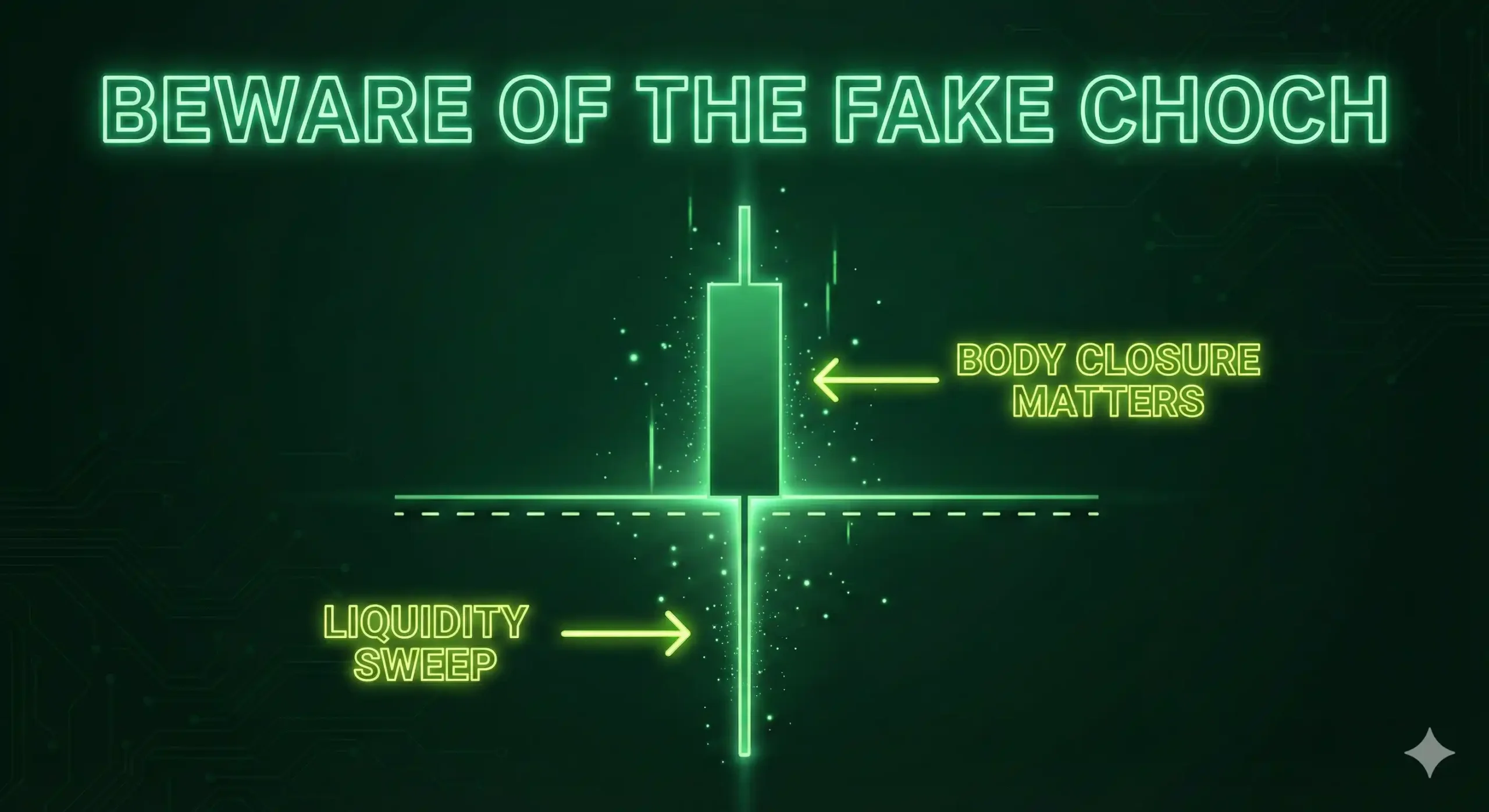
A fake CHOCH occurs when price wicks past a critical structural point solely to trigger these resting stop-loss orders. Immediately after absorbing this localized liquidity, the price aggressively reverses back into the primary trend direction. Consequently, you must cross-reference potential reversals with higher timeframe levels to avoid falling for these engineered institutional traps.
Intermediate Trading Strategies Using Break of Structure vs Change of Character
Executing profitable trades requires strictly defined entry models. You must systematically combine structural analysis with specific points of interest. Doing so allows you to capture highly asymmetric risk-to-reward opportunities consistently.
Trend Continuation Entries Following a Break of Structure (BOS)
Trading a standard BOS offers a reliable, systematic approach to following institutional momentum. The standard SMC continuation model involves successfully identifying a confirmed BOS first. After the breakout occurs, you must patiently wait for the price to retrace back into newly created institutional footprints.
Traders specifically look for pullbacks into an Order Block or a Fair Value Gap (FVG) left behind by the impulsive breakout. Technical analysts define the Order Block as the last opposing candle directly before the impulsive move that ultimately caused the BOS. Once price taps into this zone, you enter a trade in the direction of the confirmed structural break.
Trend Reversal Entries Following a Change of Character (CHOCH)
Capturing a massive trend reversal requires a higher-risk, higher-reward trading strategy. Because a CHOCH represents the very beginning of a new trend, catching the exact pivot yields incredible returns. However, a high-probability reversal setup absolutely requires a strict sequence of confluences.
- First, the overall market price must cleanly tap into a Higher Timeframe Point of Interest (HTF POI).
- Second, the Lower Timeframe (LTF) price action must definitively print a valid CHOCH.
- Finally, the trader waits for a controlled pullback into the newly formed LTF Order Block to enter the market, aggressively targeting the opposing liquidity pools.
Break of Structure vs Change of Character FAQ
Can a Change of Character (CHOCH) happen without a prior Break of Structure (BOS)?
Structurally speaking, no. A CHOCH inherently represents the absolute failure of a preceding trend structure. Furthermore, that preceding trend structure must have been previously built by a series of continuous BOS events. Market cycles operate in distinct, repeating phases of consolidation, expansion (BOS), and eventual reversal (CHOCH). Therefore, a CHOCH is always a direct structural reaction to a previously established sequence.
Which timeframe is best for trading Break of Structure vs Change of Character?
Institutional traders utilize comprehensive Multi-Timeframe Analysis (MTFA) to maximize their win rates. A widely taught standard combination used heavily in 2020-2024 SMC strategies involves analyzing the 4-Hour (4H) chart first. Traders use the 4H timeframe to identify their primary structural bias and locate major POIs. Subsequently, they drop down to the 15-minute (15m) or 5-minute (5m) charts specifically to look for a definitive CHOCH execution trigger.
How do volume metrics validate a Break of Structure (BOS) or Change of Character (CHOCH)?
While decentralized spot forex markets lack official centralized volume, futures and equity traders actively use Volume Spread Analysis (VSA). A truly valid BOS or CHOCH is typically accompanied by a massive spike in trading volume. This volume surge successfully confirms heavy institutional participation during the move. Conversely, a structural break occurring on remarkably low volume is highly indicative of a dangerous fakeout or a localized liquidity sweep.
Conclusion: Mastering Break of Structure vs Change of Character Trading
Ultimately, mastering Break of Structure vs Change of Character mechanics drastically improves your technical chart reading. You must remember the critical core distinction: a BOS confirms reliable trend continuation, whereas a CHOCH flags an early, potential trend reversal. By combining these structural signals with higher timeframe analysis, you can effectively filter out market noise and trade alongside institutional momentum. Now, you should open your preferred trading platform immediately, apply these specific definitions, and rigorously backtest these structural concepts using historical chart data to build your execution confidence.

A stock market enthusiast with hands-on experience in trading. He writes simple and practical content to help people understand the market better.