


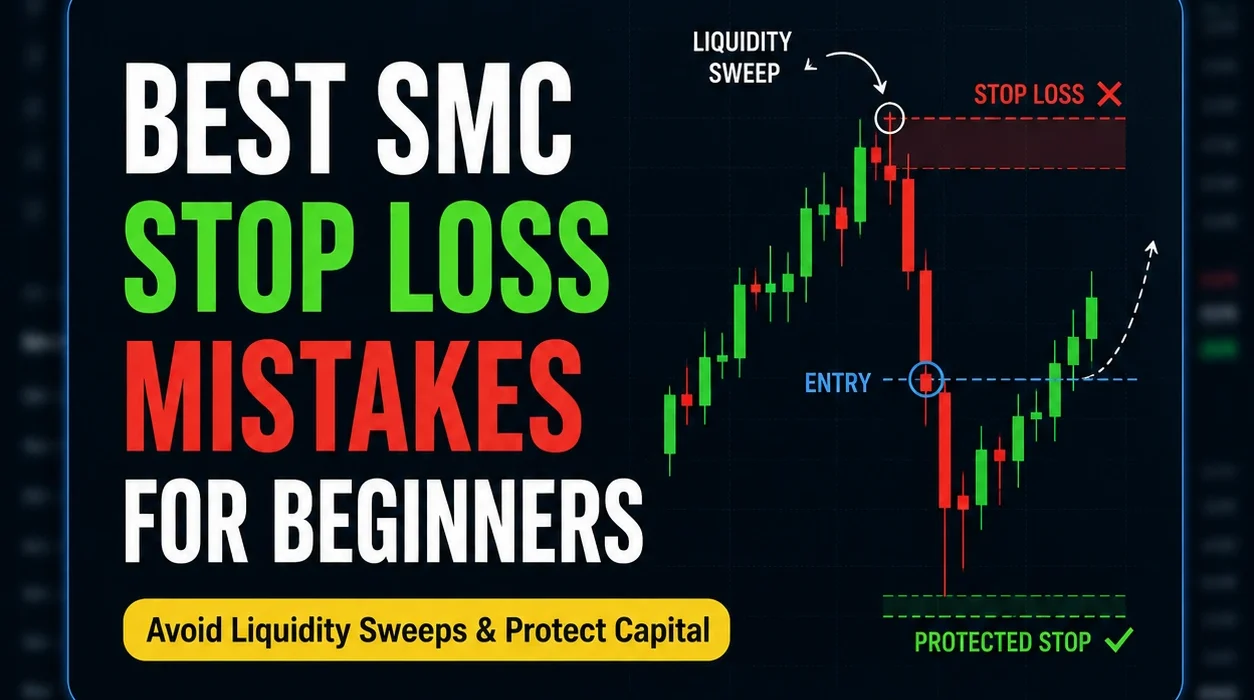
Stop loss placement is one of the most important parts of Smart Money Concepts trading. Many beginners understand market structure, liquidity, order blocks and fair value gaps, but still lose trades because their stop loss is placed at the wrong location.
In SMC trading, price often moves toward obvious stop-loss areas before making the expected move. Therefore, placing a stop directly above a recent high or below a recent low may expose the trade to a liquidity sweep.
This guide explains the most common SMC stop loss mistakes, why traders get stopped out and how beginners can place stop losses more logically.
What Is Stop Loss Placement in SMC?
A stop loss is an order used to exit a trade when price reaches a level that invalidates the trading idea. It protects the trader from uncontrolled losses.
In Smart Money Concepts, stop loss placement is not based only on a fixed number of pips. It is normally connected with market structure, liquidity, order blocks, fair value gaps and the point where the trade setup becomes invalid.
For example, suppose a trader enters a bullish trade from a demand zone. The stop loss may be placed below the structural low or below the order block that supports the bullish setup.
A good stop-loss location should answer one question:
At what price level will the original trade idea become invalid?
If the answer is unclear, the trade setup may not be ready.
Why Stop Loss Placement Is Important in SMC
SMC traders attempt to understand where orders and liquidity may be concentrated. Obvious swing highs and lows often attract stop losses from retail traders.
When many traders place their stops at the same level, that area can become a liquidity target. Price may briefly move through it, activate the stops and then reverse.
This is why beginners frequently say:
- Price touched my stop and reversed.
- My analysis was correct, but my stop was too tight.
- Price swept the low before moving upward.
- The setup worked after removing me from the trade.
These situations do not always mean deliberate manipulation. They often occur because traders place stops at obvious levels without considering volatility, liquidity and structural invalidation.
Best SMC Stop Loss Mistakes for Beginners
Placing Stop Loss Directly Below a Swing Low
One of the most common SMC stop loss mistakes is placing the stop immediately below a visible swing low in a bullish trade.
The recent low is an obvious location where many buyers may place their stops. Price may sweep this low before reacting from a deeper demand zone or order block.
Instead of automatically placing the stop under the nearest low, traders should determine whether that low is protected structure or simply an internal liquidity point.
A protected low is generally more important because breaking it may invalidate the bullish structure. A minor internal low may only be used to collect liquidity.
Placing Stop Loss Directly Above a Swing High
In a bearish setup, beginners often place the stop just above the nearest swing high.
This area may contain buy-side liquidity created by:
- Short sellers’ stop losses
- Breakout buy orders
- Pending orders above resistance
- Stops above equal highs
Price can sweep the swing high and then reverse downwards. Therefore, the stop should be based on the actual invalidation point rather than the most convenient nearby high.
Using the Same Stop Loss for Every Trade
Using a fixed stop of 10, 20 or 30 pips for every setup is another major mistake.
Every market and setup has different volatility. A stop suitable for EUR/USD may not work for gold, cryptocurrency or an index. Even on the same asset, volatility can change during different trading sessions.
A better approach is to calculate the stop according to:
- Market structure
- Setup invalidation
- Current volatility
- Entry timeframe
- Trading session
- Distance from liquidity
The position size should then be adjusted according to the stop distance.
Setting an Extremely Tight Stop Loss
Beginners often use a very tight stop because they want a large risk-to-reward ratio. However, an attractive ratio on paper does not guarantee a quality trade.
A stop placed too close to the entry may be hit by normal market fluctuations. Price needs enough space to react around order blocks, fair value gaps and liquidity zones.
Traders should not force a tight stop simply to create a 1:5 or 1:10 reward-to-risk setup. The stop must first respect the market structure.
Setting an Extremely Wide Stop Loss
A wide stop does not automatically make a trade safer. Some traders place the stop very far away because they are afraid of being stopped out.
This creates two problems. First, it increases the monetary loss when the trade fails. Second, it may keep the trader inside a setup that has already become invalid.
A stop should not be placed randomly far from the entry. It must remain connected to a logical structural level.
Ignoring Liquidity Sweeps
Ignoring liquidity is one of the biggest SMC stop loss mistakes.
Before entering a bullish setup, ask whether sell-side liquidity below the recent lows has already been taken. Before entering a bearish trade, check whether buy-side liquidity above recent highs has been swept.
When important liquidity remains untouched, price may move toward it before making the expected directional move.
For example, a trader identifies a bullish order block but enters before price sweeps equal lows. Price then drops through the equal lows, activates the trader’s stop and reverses from the order block.
The analysis may have been partially correct, but the entry was early.
Entering Before Confirmation
A poor entry often creates a poor stop-loss position.
When traders enter before confirmation, they may be forced to place a large stop or position the stop inside a liquidity zone. Waiting for confirmation can improve both entry quality and stop placement.
Useful confirmations may include:
- Liquidity sweep
- Change of character
- Break of structure
- Strong displacement
- Fair value gap formation
- Order block reaction
- Lower-timeframe retest
Confirmation does not guarantee success, but it can help traders avoid entering while price is still moving toward liquidity.
Ignoring Higher Timeframe Structure
A stop placed using only a one-minute or five-minute chart may be too close to normal price movement.
The higher timeframe can show whether the entry is occurring near major support, resistance, supply, demand or liquidity.
For example, a bearish setup on the five-minute chart may fail if price is reacting from a daily demand zone. Similarly, a bullish entry may struggle if it is directly below higher-timeframe supply.
The stop loss should reflect both lower-timeframe execution and higher-timeframe context.
Moving the Stop Loss Too Early
Many beginners move their stop loss to break-even immediately after a small favorable movement.
This may feel safe, but price frequently retraces before continuing. Moving the stop too early can remove the trader from a valid setup.
A break-even stop may be considered after:
- Price creates meaningful displacement
- A new structural high or low forms
- Partial profit is secured
- The setup reaches a planned management point
- The original risk is no longer necessary
Stop management should be planned before entering, not decided emotionally during the trade.
Moving the Stop Loss Further Away
Moving a stop further from the entry after price moves against the trade is a dangerous habit.
This usually happens because the trader does not want to accept the loss. The result can be a much larger loss than originally planned.
Once price reaches the predefined invalidation point, the trade idea should be considered failed. Widening the stop changes the original risk and can damage the trading account.
The correct response is not to move the stop. The correct response is to accept the planned loss and review the setup later.
Wrong Position Size with Stop Loss
Stop loss placement and position sizing must work together.
A wider technical stop requires a smaller position. A narrower technical stop may allow a slightly larger position, but only within the trader’s risk limit.
For example, suppose a trader risks ₹1,000 per trade. If the stop distance doubles, the position size should generally be reduced so the maximum loss remains ₹1,000.
Beginners often make the mistake of keeping the same position size even when the stop becomes wider. This creates inconsistent risk.
Real Chart Example of SMC Stop Loss Placement
Imagine that EUR/USD is bullish on the four-hour timeframe. Price retraces into a demand zone on the 15-minute chart.
Two equal lows are visible slightly above the demand zone. A beginner enters immediately when price reaches the equal lows and places the stop just beneath them.
Price breaks below the equal lows, activates the stop and reaches the deeper order block inside the demand zone. It then shows strong bullish displacement and breaks the latest lower high.
In this example:
- Equal lows represented sell-side liquidity.
- The first entry was premature.
- The stop was placed inside the liquidity area.
- The deeper order block provided the real reaction.
- Bullish displacement supplied confirmation.
A better approach would be to wait for the liquidity sweep and confirmation before considering the trade.
How to Place Stop Loss Correctly in SMC
First, identify the higher-timeframe direction and important market zones. Then mark the structural point that invalidates the setup.
For a bullish trade, the stop may be placed below:
- A protected swing low
- A valid bullish order block
- A swept liquidity low
- The demand zone supporting the setup
For a bearish trade, the stop may be placed above:
- A protected swing high
- A valid bearish order block
- A swept liquidity high
- The supply zone supporting the setup
Always calculate the position size after determining the stop distance.
10-Step SMC Stop Loss Checklist
- What is the higher-timeframe direction?
- Has important liquidity already been swept?
- Is the entry supported by structure?
- Where is the actual invalidation point?
- Is the stop inside an obvious liquidity pool?
- Is the stop too tight for current volatility?
- Is the stop unnecessarily wide?
- Has position size been adjusted?
- What is the maximum account risk?
- Is the trade management plan defined?
Conclusion
The best SMC stop loss placement is not the closest possible stop or the widest possible stop. It is the level where the original trading idea becomes invalid.
Beginners should avoid placing stops directly around obvious highs and lows without studying liquidity. They should also avoid fixed stop distances, early break-even moves, emotional stop widening and inconsistent position sizing.
A disciplined trader first identifies the invalidation point, then calculates position size and only then enters the trade. This process helps protect capital and reduces avoidable stop-outs.
This article is for educational purposes only and does not constitute financial advice.
FAQs About SMC Stop Loss Mistakes
1. Where should a stop loss be placed in SMC?
It should be placed beyond the structural level that invalidates the trade setup.
2. Why does price hit my stop and reverse?
Your stop may be located inside an obvious liquidity area near a swing high, low or equal level.
3. Should a stop be placed below an order block?
In a bullish trade, it may be placed below the order block when a break below it invalidates the setup.
4. Is a tight stop loss better?
Not always. A very tight stop may be hit by normal price volatility.
5. Is a wide stop loss safer?
No. An unnecessarily wide stop can increase losses and keep a trader inside an invalid setup.
6. Should I move my stop to break-even?
It depends on the trade plan and whether meaningful structural progress has occurred.
7. What is stop-loss hunting?
It is a common term used when price moves through obvious stop areas before reversing.
8. How much should I risk per trade?
Risk should be limited to an amount the trader can comfortably afford to lose.
9. Does liquidity need to be swept before entry?
Not in every setup, but a liquidity sweep can provide stronger context and confirmation.
10. Can correct stop placement prevent every loss?
No. Even a correctly placed stop can be hit because no trading setup is guaranteed.

A stock market enthusiast with hands-on experience in trading. He writes simple and practical content to help people understand the market better.


