


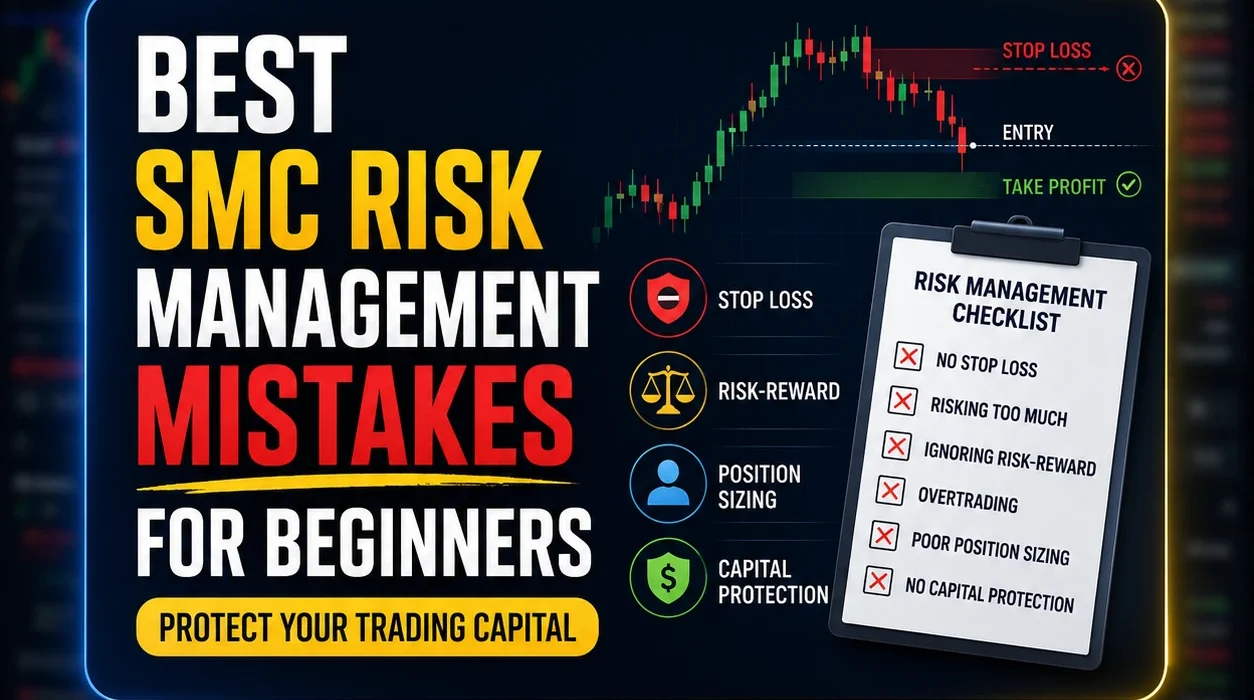
Many traders believe that becoming profitable depends only on finding the perfect entry. They spend months learning Smart Money Concepts (SMC), including liquidity, BOS, CHOCH, Order Blocks, Fair Value Gaps, Premium & Discount, and Multi-Timeframe Analysis. However, despite understanding all these concepts, most beginners still lose money consistently.
The biggest reason is poor risk management.
Learning the Best SMC Risk Management Mistakes for Beginners is more important than learning another trading strategy because even the best strategy cannot survive if money management is poor. Professional traders know that preserving capital is the first priority, while beginners usually focus only on making quick profits.
A successful trader is not someone who wins every trade. A successful trader is someone who manages losses properly, protects trading capital, and remains consistent over hundreds of trades.
In this guide, we will discuss the Best SMC Risk Management Mistakes for Beginners, why they happen, and how you can avoid them to become a disciplined and profitable trader.
Why Best SMC Risk Management Mistakes for Beginners Matter
The Best SMC Risk Management Mistakes for Beginners matter because trading is a probability game. No strategy in the world gives a 100% win rate.
Even professional institutional traders experience losing trades.
The difference is simple:
- Professionals manage losses.
- Beginners increase losses.
Good risk management allows traders to:
- Protect trading capital
- Stay emotionally stable
- Survive losing streaks
- Trade consistently
- Improve confidence
- Focus on long-term growth
Without proper risk management, even an excellent SMC strategy eventually fails.
Best SMC Risk Management Mistakes for Beginners and Risking Too Much Per Trade
One of the biggest Best SMC Risk Management Mistakes for Beginners is risking a large portion of the trading account on a single trade.
Many beginners think:
“This setup looks perfect.”
So they risk:
- 10%
- 20%
- Sometimes even 50% of their account.
The problem is simple.
No setup is guaranteed.
Even the highest-quality liquidity sweep combined with BOS, Order Block, and Fair Value Gap can fail.
Professional traders rarely risk more than 1%–2% of their capital on a single trade because they understand that trading is about probabilities, not certainty.
The goal is not to win one big trade.
The goal is to survive thousands of trades.
Best SMC Risk Management Mistakes for Beginners and Trading Without Stop Loss
Another major Best SMC Risk Management Mistakes for Beginners is avoiding stop losses.
Many beginners believe:
- “Price will come back.”
- “Market always retraces.”
- “I don’t want to get stopped out.”
Unfortunately, the market does not care about emotions.
Without a stop loss, one losing trade can wipe out weeks or even months of profits.
In Smart Money Concepts, every trade should have a predefined invalidation point.
A stop loss should always be placed where the original trade idea becomes invalid—not where you feel comfortable.
Good traders accept small losses.
Bad traders hope.
Best SMC Risk Management Mistakes for Beginners and Moving Stop Loss Emotionally
One of the most dangerous Best SMC Risk Management Mistakes for Beginners is moving the stop loss after entering a trade.
This usually happens when price moves against the trader.
Instead of accepting a small planned loss, the trader:
- Moves the stop lower.
- Gives the trade “more room.”
- Keeps hoping.
Eventually, a planned 1% loss becomes a 5% or even 10% loss.
Professional traders never do this.
If the market invalidates the setup, they simply exit and wait for another opportunity.
Remember:
Hope is never a trading strategy.
Best SMC Risk Management Mistakes for Beginners and Revenge Trading
Another common Best SMC Risk Management Mistakes for Beginners is revenge trading.
Imagine losing three trades in a row.
Most beginners immediately think:
“I have to recover my money today.”
They start:
- Increasing lot size
- Taking random entries
- Ignoring confirmation
- Breaking trading rules
Instead of recovering losses, they usually create even bigger losses.
Professional traders understand that losing trades are part of trading.
They simply follow the process and wait for high-quality setups.
Best SMC Risk Management Mistakes for Beginners and Ignoring Risk-to-Reward Ratio
One of the most overlooked Best SMC Risk Management Mistakes for Beginners is ignoring the Risk-to-Reward Ratio (RR).
Many beginners only ask:
“Will this trade win?”
Professional traders ask:
“Is this trade worth taking?”
For example:
Risk = ₹100
Possible Reward = ₹300
Risk-to-Reward = 1:3
Even if only half the trades become winners, the trader can still remain profitable.
That is why professional SMC traders focus heavily on maintaining healthy RR ratios.
Best SMC Risk Management Mistakes for Beginners and Overtrading
Another common Best SMC Risk Management Mistakes for Beginners is taking too many trades.
Beginners often believe:
More trades = More profit.
Reality is completely opposite.
Most unnecessary trades happen because of:
- FOMO
- Boredom
- Excitement
- Lack of patience
Professional traders may wait several hours for one perfect setup.
Beginners often take ten average setups instead.
Quality always beats quantity.
Best SMC Risk Management Mistakes for Beginners and Poor Position Sizing
Position sizing is another area where beginners struggle.
Many traders decide lot size randomly.
Instead, position size should always depend upon:
- Account balance
- Risk percentage
- Stop loss distance
- Market volatility
For example:
Account Size = ₹1,00,000
Risk per trade = 1%
Maximum loss allowed = ₹1,000
Your lot size should be calculated according to that ₹1,000 risk—not according to emotions.
This single habit dramatically improves long-term consistency.
Best SMC Risk Management Mistakes for Beginners and Trading Without Daily Loss Limits
One mistake that many traders never consider is the absence of a daily loss limit.
Professional traders often stop trading after reaching a fixed daily loss.
For example:
- Maximum 2 losing trades
- Maximum 3% daily loss
Once that limit is reached, trading stops.
Beginners usually continue trading until they recover everything.
Unfortunately, this often creates much bigger losses.
Setting a daily loss limit protects both capital and emotions.
Best SMC Risk Management Mistakes for Beginners and Ignoring Trading Psychology
Risk management is closely connected with psychology.
Fear and greed often create the biggest trading mistakes.
Fear causes:
- Early profit booking
- Missing good setups
- Avoiding valid entries
Greed causes:
- Holding losing trades
- Increasing lot size
- Overtrading
- Breaking rules
Professional traders manage emotions before managing money.
Discipline always beats excitement.
Best SMC Risk Management Mistakes for Beginners Conclusion
The Best SMC Risk Management Mistakes for Beginners are responsible for destroying more trading accounts than poor trading strategies.
Most beginners search for a better indicator, a better Order Block, or a better Fair Value Gap, while the real problem lies in poor money management.
A successful SMC trader understands that protecting capital is the first priority.
If your capital survives, opportunities will always come.
Remember this simple rule:
“Professional traders think about risk first and profit second.”
Master risk management, stay disciplined, follow your trading plan, and let consistency build your long-term success.
FAQs
1. What are the biggest SMC risk management mistakes?
The biggest mistakes include risking too much per trade, trading without a stop loss, revenge trading, overtrading, poor position sizing, and ignoring the Risk-to-Reward Ratio.
2. How much should beginners risk on one trade?
Most professional traders recommend risking only 1% to 2% of total trading capital on a single trade.
3. Why is stop loss important in SMC Trading?
A stop loss protects your capital and defines the point where your original trade idea becomes invalid.
4. Is Risk-to-Reward Ratio more important than win rate?
Yes. A trader with a good Risk-to-Reward Ratio can remain profitable even with a lower win rate.
5. How can beginners improve risk management?
Create a trading plan, use fixed position sizing, never risk more than 2% per trade, maintain a trading journal, and avoid emotional decision-making.

A stock market enthusiast with hands-on experience in trading. He writes simple and practical content to help people understand the market better.


4 Comments