


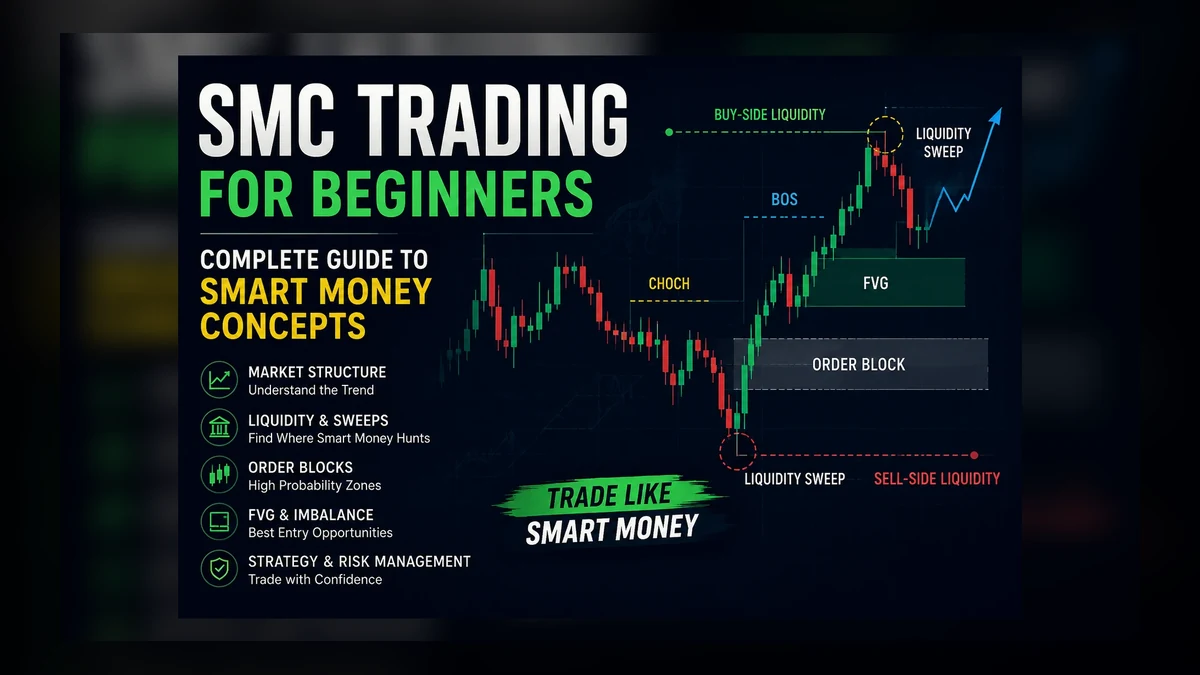
SMC trading is one of the most discussed trading approaches today because it tries to explain how price really moves in the market. Instead of depending only on indicators, SMC trading focuses on price action, liquidity, market structure, and institutional behavior. That is why many beginners and advanced traders both want to understand SMC trading in a simple way.
SMC trading stands for Smart Money Concepts trading. The main idea behind SMC trading is that markets are often driven by big players like institutions, banks, hedge funds, and large liquidity providers. These players need liquidity to enter and exit large positions, and SMC trading tries to study those footprints through price behavior. If you understand how liquidity is taken, how structure breaks, and where price reacts, SMC trading can help you read charts with more clarity.
SMC Trading Meaning and Why It Matters
SMC trading is based on the belief that price does not move randomly. According to SMC trading, the market usually movOrder Block Tradinges from one liquidity area to another. Price may sweep highs, take lows, trap retail traders, and then continue in the real direction. This is why many people feel confused when the market hits their stop loss and then moves exactly where they expected. SMC trading tries to explain this behavior.
The reason SMC trading matters is simple. Many traders buy resistance breakouts and sell support breakdowns without understanding the deeper structure behind them. But SMC trading asks different questions: Where is liquidity sitting? Has market structure shifted? Did price create displacement? Is there an order block or fair value gap? These questions help traders see more context before taking a trade.
SMC Trading vs Traditional Technical Analysis
SMC trading is not completely separate from technical analysis, but it looks at the chart in a different way. Traditional technical analysis often focuses on trendlines, indicators, chart patterns, and moving averages. SMC trading focuses more on structure, liquidity, imbalance, and institutional zones.
For example, a normal trader may see resistance and wait for a breakout. But in SMC trading, a trader may wait for price to first grab liquidity above resistance, then show rejection, then break structure, and only after that look for an entry. This makes SMC trading more context-based than indicator-based.
That does not mean SMC trading is always better. It means SMC trading is more detailed and requires more patience. Traders who like clean chart reading often prefer SMC trading because it removes unnecessary noise and brings attention back to raw price action.
ALSO READ: Infosys Ltd share price target 2026, 2027, 2028, 2029, 2030, 2031 — Future Forecast, Monthly Outlook
SMC Trading and Market Structure
The foundation of SMC trading is market structure. Without understanding structure, you cannot apply SMC trading properly. Market structure simply means how price is forming highs and lows.
In an uptrend, price forms higher highs and higher lows. In a downtrend, price forms lower highs and lower lows. In SMC trading, this structure is very important because it shows whether the market is continuing or changing direction.
When using SMC trading, always start by marking the major swings on the chart. Then ask whether the market is trending up, trending down, or ranging. This step sounds basic, but it is one of the most important parts of SMC trading. Many traders fail because they jump directly to order blocks and fair value gaps without first identifying the main structure.
SMC Trading and BOS vs CHOCH
Two very important terms in SMC trading are BOS and CHOCH.
BOS means Break of Structure. In SMC trading, BOS usually confirms continuation. For example, if price is making higher highs and higher lows, and then breaks above the previous high, that can be treated as a bullish BOS.
CHOCH means Change of Character. In SMC trading, CHOCH usually suggests a possible shift in trend. For example, if a market was bullish and then suddenly breaks below a key higher low, that can be the first sign that bullish control is weakening.
A good way to think about SMC trading is this: BOS confirms continuation, while CHOCH warns of possible reversal. But context matters. One CHOCH alone does not guarantee a full reversal. That is why in SMC trading, traders wait for confirmation, liquidity reaction, and entry zone alignment.
SMC Trading and Liquidity
Liquidity is one of the core ideas in SMC trading. In simple words, liquidity means areas where many stop losses or pending orders are sitting. These areas often form above equal highs, below equal lows, around swing points, and near obvious support or resistance.
In SMC trading, buy-side liquidity usually sits above highs, and sell-side liquidity usually sits below lows. Big market participants often need this liquidity to fill their large orders. That is why price sometimes moves above a visible high, triggers breakout traders, takes stop losses, and then reverses. SMC trading calls this a liquidity sweep or liquidity grab.
Once you understand liquidity, SMC trading becomes much clearer. You stop asking, “Why did price suddenly reverse?” and start asking, “What liquidity did price just take?” That shift in thinking is one of the biggest benefits of SMC trading.
SMC Trading and Order Blocks
Another key concept in SMC trading is the order block. An order block is usually the last bearish candle before a strong bullish move, or the last bullish candle before a strong bearish move. In SMC trading, these zones are considered important because they may represent institutional positioning.
A bullish order block in SMC trading is often used as a possible buy zone after price confirms bullish intent. A bearish order block is often used as a possible sell zone after bearish confirmation. But not every candle is a valid order block. A stronger order block in SMC trading usually appears near a liquidity grab, before displacement, and around a structure break.
This is why traders should not blindly mark random candles. In SMC trading, an order block becomes more useful when it is supported by structure, liquidity, and price displacement.
SMC Trading and Fair Value Gaps
Fair Value Gap, or FVG, is another major concept in SMC trading. An FVG is a gap or imbalance created when price moves aggressively in one direction. It usually appears when there is a strong candle and the surrounding candles leave an unfilled space in price movement.
In SMC trading, traders believe that price often returns to these imbalances before continuing in the original direction. That is why FVGs are used as possible entry or reaction areas. For example, if bullish structure is confirmed and price leaves a bullish fair value gap, a trader using SMC trading may wait for price to return into that gap and then look for entry confirmation.
Fair value gaps are helpful because SMC trading is not only about identifying direction. It is also about finding efficient entry zones. A well-placed FVG can give tighter risk and better reward.
SMC Trading Entry Model for Beginners
A simple SMC trading entry model can be followed step by step:
First, identify the higher-timeframe trend.
Second, mark major liquidity areas.
Third, wait for price to sweep liquidity.
Fourth, wait for BOS or CHOCH confirmation.
Fifth, mark the order block or fair value gap.
Sixth, wait for price to retrace into that zone.
Seventh, enter with proper stop loss and target.
This process makes SMC trading much easier for beginners. The biggest mistake beginners make in SMC trading is entering too early. They see an order block and enter immediately. But good SMC trading is not about random zones. It is about the full sequence: liquidity, structure, displacement, and reaction.
SMC Trading and Risk Management
No strategy works without risk management, and SMC trading is no exception. In fact, because SMC trading often uses tight stop losses, discipline becomes even more important. If you risk too much per trade, one wrong trade can damage your account.
A smart approach in SMC trading is to risk a fixed percentage on each trade, such as 1% or less. Always place stop loss beyond the invalidation point, not just randomly. Also, never force trades just because you see an order block or FVG. Good SMC trading requires patience.
Risk management also means knowing when not to trade. If structure is unclear, liquidity is messy, or price is inside a choppy range, it is better to stay out. The best SMC trading setups are usually clean, obvious, and aligned across multiple factors.
Common Mistakes in SMC Trading
Many traders fail in SMC trading because they overcomplicate it. They mark too many zones, too many liquidity levels, and too many structure shifts. But SMC trading should simplify your chart, not make it more confusing.
Another common mistake in SMC trading is ignoring higher timeframes. A perfect lower-timeframe entry can fail if the higher-timeframe trend is against it. Traders also fail when they assume every liquidity sweep will reverse the market. In SMC trading, context is everything.
Some other mistakes include:
- trading without confirmation
- using oversized lot sizes
- chasing price after displacement
- forcing trades in low-quality zones
- focusing only on entries and ignoring exits
The more you practice, the more natural SMC trading will become.
Is SMC Trading Good for Beginners?
Yes, SMC trading can be good for beginners, but only if they learn it step by step. A beginner should first understand market structure, then liquidity, then BOS and CHOCH, and only after that move into order blocks and fair value gaps.
The problem is not SMC trading itself. The problem is that many people try to learn advanced parts without building the foundation. If you keep it simple, SMC trading can actually make chart reading easier because it teaches you to focus on what really matters.
Conclusion
SMC trading is a powerful way to understand how price moves in the market. Instead of depending on random entries or lagging indicators, SMC trading helps traders read structure, liquidity, imbalances, and high-probability reaction zones. When used correctly, SMC trading can improve timing, reduce emotional trading, and create better trade planning.
At the same time, SMC trading is not magic. It does not guarantee profits, and it still requires patience, screen time, and proper risk management. The best way to learn SMC trading is to keep the chart clean, focus on structure first, and build confidence with simple setups before moving to advanced models. If you stay disciplined, SMC trading can become a strong framework for long-term trading improvement.
FAQs
What is SMC trading in simple words?
SMC trading means Smart Money Concepts trading. It is a way of reading charts by focusing on market structure, liquidity, order blocks, and fair value gaps.
Is SMC trading better than technical analysis?
SMC trading is a part of technical analysis, but it is more focused on price action and institutional behavior. Some traders prefer SMC trading because it gives more context.
What are the main concepts in SMC trading?
The main concepts in SMC trading are market structure, BOS, CHOCH, liquidity, liquidity sweep, order block, fair value gap, premium, and discount zones.
Can beginners learn SMC trading?
Yes, beginners can learn SMC trading if they start with basics like highs, lows, trend, and structure before learning advanced concepts.
Is SMC trading profitable?
SMC trading can be profitable when combined with patience, discipline, and risk management. But like every trading method, SMC trading also has losing trades.

A stock market enthusiast with hands-on experience in trading. He writes simple and practical content to help people understand the market better.


