


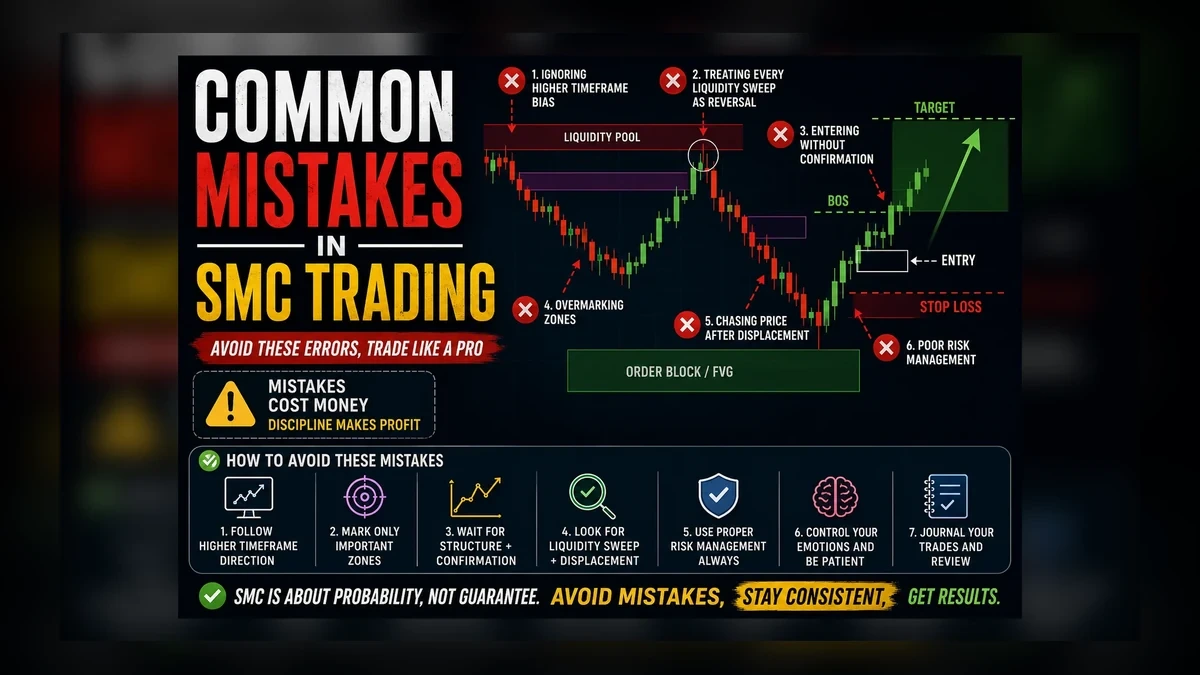
Price Action in SMC Trading is the foundation of Smart Money Concepts, and without it no trader can properly understand liquidity, order blocks, fair value gaps, BOS, or CHOCH. Many beginners try to jump directly into advanced SMC setups, but the truth is simple: if your understanding of Price Action in SMC Trading is weak, then every chart will look confusing. That is why building the right base is the first step.
Price Action in SMC Trading means understanding how price actually moves on a chart without depending too much on indicators. It is about reading candles, identifying swing highs and swing lows, understanding trend direction, and seeing where price reacts strongly. Once you understand Price Action in SMC Trading, the market starts looking more logical and less random. You stop chasing every move and start reading what the chart is trying to say.
Price Action in SMC Trading Meaning
Price Action in SMC Trading simply means studying the movement of price directly from the chart. Instead of depending on moving averages, RSI, MACD, or random signals, a trader focuses on what price is doing in real time. Every candle, every swing, and every breakout gives information. The goal of Price Action in SMC Trading is to learn how to read that information clearly.
The best thing about Price Action in SMC Trading is that it keeps the chart clean. A clean chart helps a trader focus on market behavior rather than indicator confusion. If price is moving up strongly, that matters. If price keeps rejecting one zone, that matters. If price is forming higher highs and higher lows, that matters. This is exactly what Price Action in SMC Trading teaches.
Price Action in SMC Trading and Why It Matters
Price Action in SMC Trading matters because Smart Money Concepts is built on the movement of price, not on lagging indicators. Liquidity sweeps, order blocks, displacement, and fair value gaps all come after price movement. If you do not understand how price moves, then these advanced concepts become difficult to use correctly.
For example, if you cannot identify whether the market is trending or ranging, then you may mark a bullish order block in a bearish market and take a weak trade. If you cannot identify an impulsive move, then you may confuse a normal pullback with a reversal. That is why Price Action in SMC Trading is not a small topic. It is the core topic.
A trader who understands Price Action in SMC Trading can do three things better than most beginners. First, they can read trend more clearly. Second, they can wait for better entries. Third, they can avoid low-quality trades. This is why the foundation matters so much.
Price Action in SMC Trading and Candle Reading
Price Action in SMC Trading starts with candle reading. Candles are not just red and green boxes. Each candle represents buying pressure, selling pressure, rejection, and hesitation. A strong bullish candle may show aggressive buying, while a long upper wick may show rejection from higher prices.
In Price Action in SMC Trading, candles are not studied in isolation. One candle alone does not tell the full story. You have to study candles in context. A bullish candle at a key support area means more than a bullish candle in the middle of nowhere. A rejection wick near a previous high means more than a rejection wick in a random place.
To improve Price Action in SMC Trading, focus on:
- body size
- wick size
- candle close
- candle location
- candle sequence
If three or four strong bullish candles appear after a correction, that may show strength. If price gives small candles and repeated rejections near a zone, that may show hesitation. Reading this correctly is a major part of Price Action in SMC Trading.
Price Action in SMC Trading and Swing Highs and Swing Lows
Price Action in SMC Trading becomes much easier when you understand swing highs and swing lows. A swing high is a point where price pushes up and then turns downward. A swing low is a point where price pushes down and then turns upward. These swing points build structure.
In Price Action in SMC Trading, structure is created by these highs and lows. If price keeps making higher highs and higher lows, the trend is bullish. If price keeps making lower highs and lower lows, the trend is bearish. If price is moving between similar highs and similar lows, the market may be ranging.
Many beginners make the mistake of marking every tiny movement. But Price Action in SMC Trading works better when you first mark the obvious major swings. Once your eyes get trained, you can study internal structure later. First learn the main moves, then go deeper.
Price Action in SMC Trading and Trend Identification
Price Action in SMC Trading is closely connected with trend reading. If you misread trend, you will often trade in the wrong direction. That is why one of the first jobs in Price Action in SMC Trading is to identify whether the market is bullish, bearish, or ranging.
A bullish market usually forms higher highs and higher lows.
A bearish market usually forms lower highs and lower lows.
A range market usually forms repeated highs and repeated lows.
In Price Action in SMC Trading, trend is not guessed. Trend is observed from structure. This keeps the process objective. If the market is bullish, then you look for bullish continuation or bullish setup quality. If the market is bearish, then you look for bearish structure and weaker upward corrections.
Price Action in SMC Trading and Impulsive Moves
Price Action in SMC Trading gives a lot of importance to impulsive moves. An impulsive move is a strong directional move with clear momentum. These moves usually have larger candles, less hesitation, and fast movement. In a bullish market, an impulsive bullish move shows buyer strength. In a bearish market, an impulsive bearish move shows seller strength.
Impulsive moves matter in Price Action in SMC Trading because they show where real strength exists. If price moves up aggressively and then only pulls back slowly, that often suggests the bullish side is still strong. If price drops heavily and then retraces weakly, that often suggests bearish continuation is possible.
When you study Price Action in SMC Trading, always ask:
- Which move was stronger?
- Which move had better momentum?
- Did price move cleanly or slowly?
- Did the move break previous structure?
These questions improve chart reading a lot.
Price Action in SMC Trading and Corrective Moves
Price Action in SMC Trading also teaches the difference between impulsive and corrective moves. A corrective move is a retracement or pullback against the main trend. These moves are usually slower, smaller, and less aggressive than impulsive moves.
In Price Action in SMC Trading, many traders lose patience during corrections. They think the trend is over, but often it is just a pullback. A market cannot move in one direction forever. It needs to breathe, retrace, rebalance, and then continue. That is why corrective moves are normal.
If the main trend is bullish and price pulls back slowly after a strong impulsive bullish move, then that correction may simply be preparing the next leg up. Understanding this concept is very important in Price Action in SMC Trading, because it helps traders avoid emotional exits and bad reversal entries.
Price Action in SMC Trading and Support and Resistance
Price Action in SMC Trading also includes support and resistance reading. Even though SMC uses terms like liquidity, mitigation, and premium-discount zones, basic support and resistance still matter. These are reaction areas where price has previously respected a level.
A support area is where price tends to react upward. A resistance area is where price tends to react downward. In Price Action in SMC Trading, these zones become stronger when they align with structure, sweeps, or strong candles.
The key is not to draw too many levels. In Price Action in SMC Trading, quality matters more than quantity. A few clean reaction zones are more useful than a chart full of lines. Traders should mark levels that clearly caused strong reactions in the past.
Price Action in SMC Trading and Chart Context
Price Action in SMC Trading is not just about candles and highs and lows. It is also about context. A setup is never strong just because one candle looks good. The real question is where that candle forms and what the market was doing before that candle appeared.
For example, a bullish rejection candle near a major swing low inside a bullish structure is much more meaningful than the same candle in the middle of a range. Context gives meaning. This is one of the biggest strengths of Price Action in SMC Trading.
To understand context in Price Action in SMC Trading, always check:
- trend direction
- key swing points
- nearby liquidity
- recent momentum
- reaction zones
When all these things align, the chart becomes easier to read and your confidence improves.
Price Action in SMC Trading and Common Beginner Mistakes
Price Action in SMC Trading looks simple, but beginners still make common mistakes. One major mistake is overcomplicating the chart. Another mistake is forcing trades in unclear conditions. Many traders also confuse every correction with a reversal.
Some common mistakes in Price Action in SMC Trading are:
- marking too many swing points
- ignoring higher timeframe trend
- entering without patience
- mixing too many indicators
- trading in messy ranges
- chasing late entries after big moves
The solution is simple. Keep the process clean. Build your analysis step by step. Focus on obvious structure first. Then slowly add more detail. Good Price Action in SMC Trading is clear, simple, and logical.
Price Action in SMC Trading and How to Practice Daily
Price Action in SMC Trading improves with observation and repetition. The best practice is daily chart study. Open one clean chart and mark:
- the major trend
- the most important swing high
- the most important swing low
- the latest impulsive move
- the latest corrective move
- the nearest reaction zone
This daily routine helps build confidence. You can also use replay mode and study old charts candle by candle. Pause the chart and ask what price is doing. This is one of the best ways to improve Price Action in SMC Trading.
A journal is also useful. Take screenshots of charts and note what you observed. Over time, your eyes become trained. That is the real benefit of consistent practice in Price Action in SMC Trading.
Conclusion
Price Action in SMC Trading is the real foundation of Smart Money Concepts. Without understanding candles, swing highs, swing lows, trend direction, impulsive moves, and corrective moves, advanced SMC ideas remain incomplete. That is why Price Action in SMC Trading should always be learned first.
The good news is that Price Action in SMC Trading is not difficult when learned step by step. A trader does not need to memorize everything at once. Start with clean charts, basic structure, trend reading, and reaction zones. Once this base becomes strong, the rest of SMC becomes much easier. A strong foundation in Price Action in SMC Trading improves clarity, patience, and long-term trading confidence.
ALSO READ: SMC Trading for Beginners: Complete Guide to Smart Money Concepts In 2026
FAQs
What is Price Action in SMC Trading?
Price Action in SMC Trading means studying raw price movement through candles, structure, swing highs, swing lows, impulsive moves, and corrective moves without depending too much on indicators.
Why is Price Action in SMC Trading important?
Price Action in SMC Trading is important because it builds the base for understanding liquidity, BOS, CHOCH, order blocks, fair value gaps, and entries.
How do beginners learn Price Action in SMC Trading?
Beginners can learn Price Action in SMC Trading by marking swing highs, swing lows, identifying trend, and studying impulsive and corrective moves on clean charts every day.
What is an impulsive move in Price Action in SMC Trading?
In Price Action in SMC Trading, an impulsive move is a strong directional move with momentum, while a corrective move is a slower retracement or pullback.
Can I learn advanced SMC without Price Action in SMC Trading?
No. Price Action in SMC Trading is the base of Smart Money Concepts. Without it, advanced SMC concepts often become confusing and difficult to apply properly.

A stock market enthusiast with hands-on experience in trading. He writes simple and practical content to help people understand the market better.


