


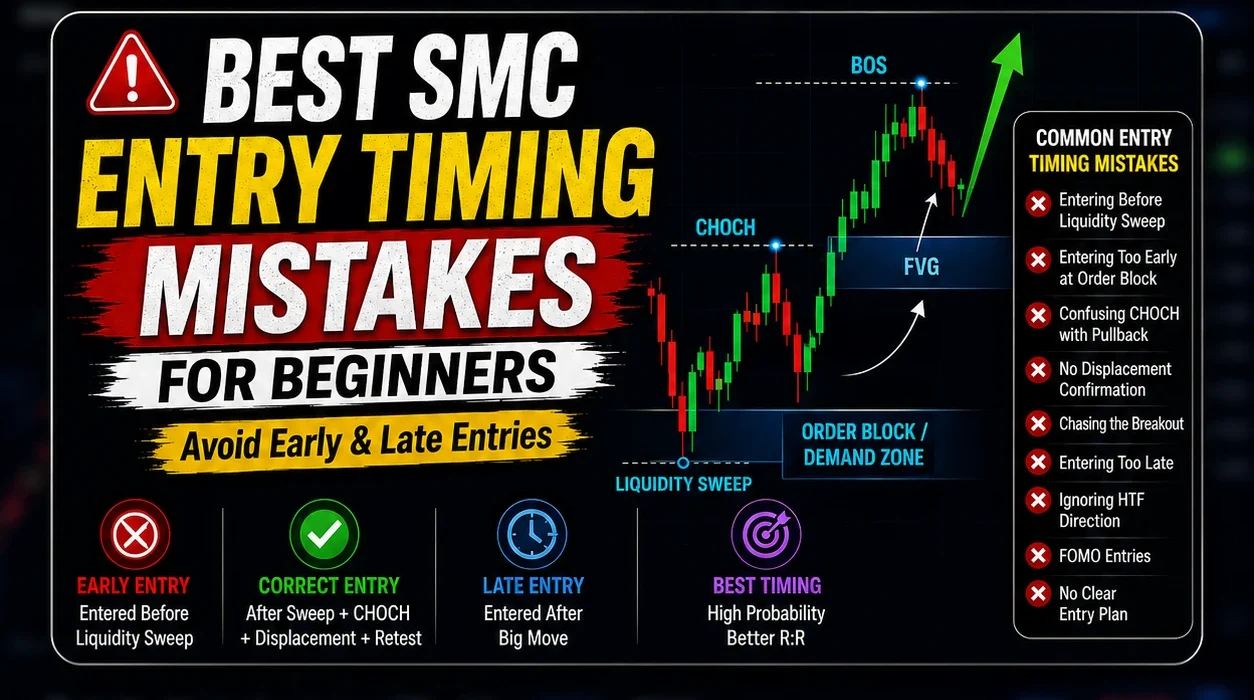
Entry timing is one of the most difficult parts of Smart Money Concepts trading. A trader may correctly identify market structure, liquidity, an order block or a fair value gap, but still lose because the trade was entered too early or too late.
Many beginners believe that finding the correct zone is enough. However, price can move through an order block, sweep nearby liquidity or create another lower-timeframe setup before making the expected move. Poor timing can therefore turn a good analysis into a losing trade.
This guide explains the most common SMC entry timing mistakes, why beginners enter at the wrong moment and how to improve entries using liquidity, market structure and confirmation.
What Is Entry Timing in SMC?
Entry timing in Smart Money Concepts refers to choosing the appropriate moment to enter a trade after analysing structure, liquidity and important price zones.
A complete SMC setup may include:
- Higher-timeframe market direction
- Buy-side or sell-side liquidity
- Order block
- Fair value gap
- Liquidity sweep
- Change of character
- Break of structure
- Displacement
- Lower-timeframe confirmation
Entry timing determines when the trader acts on this information.
For example, a trader may identify a bullish order block. Entering immediately when price first touches the zone is an aggressive entry. Waiting for sell-side liquidity to be swept and a bullish change of character is a confirmation-based entry.
Both approaches may work, but they involve different levels of risk. Beginners often lose because they enter without understanding which entry model they are using.
Why Entry Timing Matters in SMC Trading
Price does not always reverse immediately after reaching an order block, demand zone or fair value gap. It may continue deeper into the zone before reacting.
When an entry is too early, the trader may be stopped out before the real setup forms. When an entry is too late, the trader may receive a poor risk-to-reward ratio or enter after most of the move has already occurred.
Correct entry timing helps traders:
- Avoid premature trades
- Reduce unnecessary stop-outs
- Improve risk-to-reward
- Enter after liquidity is taken
- Avoid chasing price
- Place a logical stop loss
- Follow a repeatable trading plan
Good entry timing does not guarantee a winning trade, but it improves the quality of execution.
Best SMC Entry Timing Mistakes for Beginners
Entering Before a Liquidity Sweep
One of the most common SMC entry timing mistakes is entering before price has collected nearby liquidity.
Imagine that price is moving toward a bullish order block, but equal lows are visible just above the zone. These equal lows may contain sell-side liquidity.
A beginner may enter as soon as price touches the equal lows. Price then moves lower, sweeps the liquidity and reaches the actual order block. The trader gets stopped out before the bullish reversal begins.
Before entering, ask:
- Is important liquidity still untouched?
- Are equal highs or equal lows visible?
- Is the market likely to sweep a recent swing point?
- Has price reached the main higher-timeframe zone?
Waiting for the liquidity event can prevent many early entries.
Entering Immediately at an Order Block
Order blocks are not automatic entry signals.
Beginners often mark every bullish or bearish candle before a strong move as an order block. They then place a limit order without checking whether the zone is valid.
A strong order block should generally be supported by context such as:
- Liquidity sweep
- Market structure shift
- Strong displacement
- Fair value gap
- Higher-timeframe alignment
- Clear reaction from the zone
Entering immediately at an unconfirmed order block may expose the trader to deeper retracement or complete invalidation.
An aggressive entry can be used by experienced traders, but beginners should normally wait for confirmation until they have tested the setup thoroughly.
Entering Before Change of Character
A change of character, commonly called CHOCH, may indicate that the short-term market direction is changing.
For a bullish setup, price may first sweep a low and then break the latest lower high. For a bearish setup, price may sweep a high and then break the latest higher low.
Entering before this shift means the trader is trying to predict the reversal while the current structure is still active.
For example, price is making lower highs and lower lows. A beginner buys from a demand zone without waiting for any bullish structure shift. Price continues lower and reaches another liquidity area.
Waiting for CHOCH does not eliminate risk, but it can provide evidence that momentum is beginning to change.
Confusing CHOCH with a Minor Pullback
Not every small break is a genuine market structure shift.
Beginners may identify a minor candle high as CHOCH and enter immediately. However, the break may only represent an internal pullback inside a larger bearish move.
To avoid this mistake, traders should analyse:
- Whether the broken swing is structurally important
- Whether displacement accompanied the break
- Whether liquidity was swept first
- Whether the setup aligns with higher-timeframe direction
- Whether price closed beyond the level
A weak wick above a small internal high may not be enough to confirm a bullish reversal.
Entering Without Displacement
Displacement is a strong and decisive price movement that shows clear buying or selling pressure.
A valid displacement move may:
- Break an important swing
- Leave a fair value gap
- Close strongly beyond structure
- Show momentum away from a key zone
Beginners sometimes enter after a weak CHOCH with small candles and no clear momentum. Such a move may fail because the market has not shown strong intent.
A cleaner entry model is:
Liquidity sweep → CHOCH → displacement → retracement → entry
This sequence provides more information than entering immediately after the first small reaction.
Entering Too Late After a Large Move
Late entry is another major SMC entry timing mistake.
A trader may wait for too many confirmations. By the time the trader enters, price has already moved far from the order block or fair value gap.
Late entry creates several problems:
- Stop loss becomes wider
- Risk-to-reward becomes poor
- Price may be close to opposing liquidity
- Retracement risk increases
- Emotional decision-making begins
A trader should not chase a move simply because the analysis appears correct. When price has already travelled too far, the best decision may be to wait for another setup.
Missing a trade is better than entering at a poor location.
Chasing a Break of Structure
A strong break of structure often attracts late traders.
Suppose price breaks above a previous high with a large bullish candle. A beginner enters at the top because the breakout looks powerful.
Price then retraces into the fair value gap or order block created by the displacement. The trader experiences immediate drawdown or gets stopped out.
Instead of chasing the breakout, wait for price to retrace into a logical entry area.
Possible retracement locations include:
- Fair value gap
- Order block
- Breaker block
- Discount zone
- Previous resistance turned support
- Lower-timeframe demand
The structure break confirms direction, but it does not always provide the best entry price.
Ignoring Premium and Discount
Premium and discount help traders avoid buying too high or selling too low within a dealing range.
In a bullish setup, traders generally look for buying opportunities in the discount portion of the range. In a bearish setup, traders generally prefer selling from the premium portion.
A beginner may identify bullish structure but enter after price has already reached the premium area. Even if the market remains bullish, the entry may offer limited upside and increased retracement risk.
Similarly, selling from discount may result in entering near the bottom of the range.
Premium and discount should not be used alone, but they can improve entry location.
Entering Against Higher-Timeframe Direction
A lower-timeframe setup may look attractive while opposing the dominant higher-timeframe structure.
For example, the daily chart is bullish and price is trading inside a higher-timeframe demand zone. On the five-minute chart, a small bearish CHOCH appears.
A beginner may enter a short trade immediately. However, the bearish move may only be a temporary pullback before the higher-timeframe bullish trend continues.
Before entering, check:
- Daily direction
- Four-hour structure
- Major supply and demand zones
- Higher-timeframe liquidity targets
- Current dealing range
Lower-timeframe entries are generally stronger when they align with higher-timeframe context.
Entering During Unfavourable Market Conditions
Not every trading session offers clean SMC setups.
Entry timing can become difficult during:
- Low-volume periods
- Major economic announcements
- Sudden volatility
- Market opening gaps
- Very narrow ranges
- Illiquid sessions
- Unusual spreads
A technically correct setup may fail when market conditions are unstable.
Beginners should know when their chosen market is most active. They should also avoid entering immediately before high-impact news unless their strategy is specifically designed for such conditions.
Entering Because of Fear of Missing Out
Fear of missing out is one of the main reasons traders enter late.
A trader sees price moving quickly and believes that the opportunity will disappear. The trader enters without confirmation, without calculating risk and without checking the target.
This emotional entry often happens after:
- A large displacement candle
- A breakout
- A sudden liquidity sweep
- A social-media trade signal
- Several missed trades
- A recent losing trade
A trading plan should define exactly what must happen before an entry is allowed. When the conditions are incomplete, the trader should not enter.
Entering Without a Defined Stop Loss
A trade should not be entered before the invalidation point is clear.
Some beginners enter first and then decide where to place the stop. This may result in an extremely tight stop, excessively wide stop or emotionally adjusted stop.
Before entering, determine:
- Entry price
- Structural invalidation
- Stop-loss distance
- Position size
- Target
- Maximum account risk
If the stop cannot be placed logically, the setup should be avoided.
Using the Same Entry Timeframe for Every Setup
Different setups may require different execution timeframes.
A swing trader using the four-hour chart may refine entries on the 15-minute chart. A day trader using the 15-minute direction may execute on the one-minute or five-minute chart.
Beginners sometimes switch randomly between timeframes until they find a signal that supports their opinion. This creates inconsistency.
A structured timeframe model may look like:
- Daily chart for overall direction
- Four-hour chart for major zones
- 15-minute chart for setup formation
- Five-minute chart for confirmation
- One-minute chart only for precise execution
The chosen timeframe model should remain consistent during backtesting and live trading.
Real Chart Example of an SMC Entry Timing Mistake
Imagine that GBP/USD is bullish on the four-hour chart. Price is retracing toward a higher-timeframe demand zone.
On the 15-minute chart, equal lows are visible above a bullish order block. A beginner enters when price first touches the equal lows because the trader expects an immediate reversal.
Price falls below the equal lows, sweeps sell-side liquidity and reaches the order block. The first trader is stopped out.
After the sweep, price forms strong bullish displacement and breaks the latest lower high. A fair value gap is created during the structure break.
Price then retraces into the fair value gap and continues higher.
In this example:
- The higher-timeframe direction was bullish.
- Equal lows represented sell-side liquidity.
- The first entry was too early.
- The liquidity sweep occurred before the actual reversal.
- CHOCH and displacement provided confirmation.
- The fair value gap offered a better entry.
The original market idea was correct, but the timing was poor.
How to Improve SMC Entry Timing
Begin by analysing the higher-timeframe direction and identifying the main liquidity target.
Next, mark the important order blocks, fair value gaps, swing highs, swing lows, equal highs and equal lows.
Wait for price to reach a meaningful location. Do not enter simply because price is moving toward the zone.
Look for a logical sequence:
- Price reaches a higher-timeframe area.
- Relevant liquidity is swept.
- Lower-timeframe structure shifts.
- Strong displacement confirms intent.
- A fair value gap or order block is formed.
- Price retraces into the entry zone.
- Stop loss is placed beyond invalidation.
- Position size is calculated.
- Target is selected from opposing liquidity.
- The trade is managed according to plan.
This approach may produce fewer trades, but the entries are generally more structured.
10-Step SMC Entry Timing Checklist
Before entering any SMC trade, ask:
- What is the higher-timeframe direction?
- Is price at a meaningful supply or demand zone?
- Where is the nearest liquidity?
- Has important liquidity been swept?
- Has a valid CHOCH or BOS occurred?
- Was the structure break supported by displacement?
- Is there a fair value gap or order block for entry?
- Am I entering from premium or discount correctly?
- Is the stop loss beyond the invalidation point?
- Is the risk-to-reward still acceptable?
If several answers are unclear, the setup may need more time.
Conclusion
The best SMC entry timing is not about entering at the exact top or bottom. It is about waiting for enough confirmation while avoiding a late chase.
Beginners commonly enter before liquidity sweeps, buy immediately at order blocks, misunderstand CHOCH, chase breakouts and ignore higher-timeframe context. These mistakes can be reduced with a clear entry model.
A strong entry process combines location, liquidity, structure, displacement and risk management. Traders should focus on repeatable execution rather than perfect entries.
Missing a setup is not a loss. Entering without confirmation and proper risk control can become one.
This article is for educational purposes only and does not constitute financial advice.
FAQs About SMC Entry Timing Mistakes
1. What is the best entry confirmation in SMC?
A liquidity sweep followed by a structure shift, displacement and retracement into a fair value gap or order block is a commonly used confirmation model.
2. Should I enter immediately at an order block?
Beginners may benefit from waiting for lower-timeframe confirmation instead of entering automatically.
3. What is an early entry in SMC?
An early entry occurs before liquidity is swept or before the market shows a valid directional confirmation.
4. What is a late entry in SMC?
A late entry occurs after price has already moved far from the original setup zone.
5. Is CHOCH enough for entry?
Not always. The CHOCH should be evaluated with liquidity, displacement and higher-timeframe context.
6. Should I enter after BOS?
Rather than chasing the break, traders often wait for a retracement into a fair value gap or order block.
7. Which timeframe is best for SMC entries?
The best timeframe depends on the trading style, but lower timeframes are commonly used for execution after higher-timeframe analysis.
8. Why do I get stopped out before price reverses?
You may be entering before a liquidity sweep or placing the stop inside an obvious liquidity area.
9. How can I avoid FOMO entries?
Use a written entry checklist and avoid trades that do not meet every required condition.
10. Can perfect entry timing eliminate losses?
No. Even well-timed entries can fail because every trading setup carries risk.

A stock market enthusiast with hands-on experience in trading. He writes simple and practical content to help people understand the market better.


