


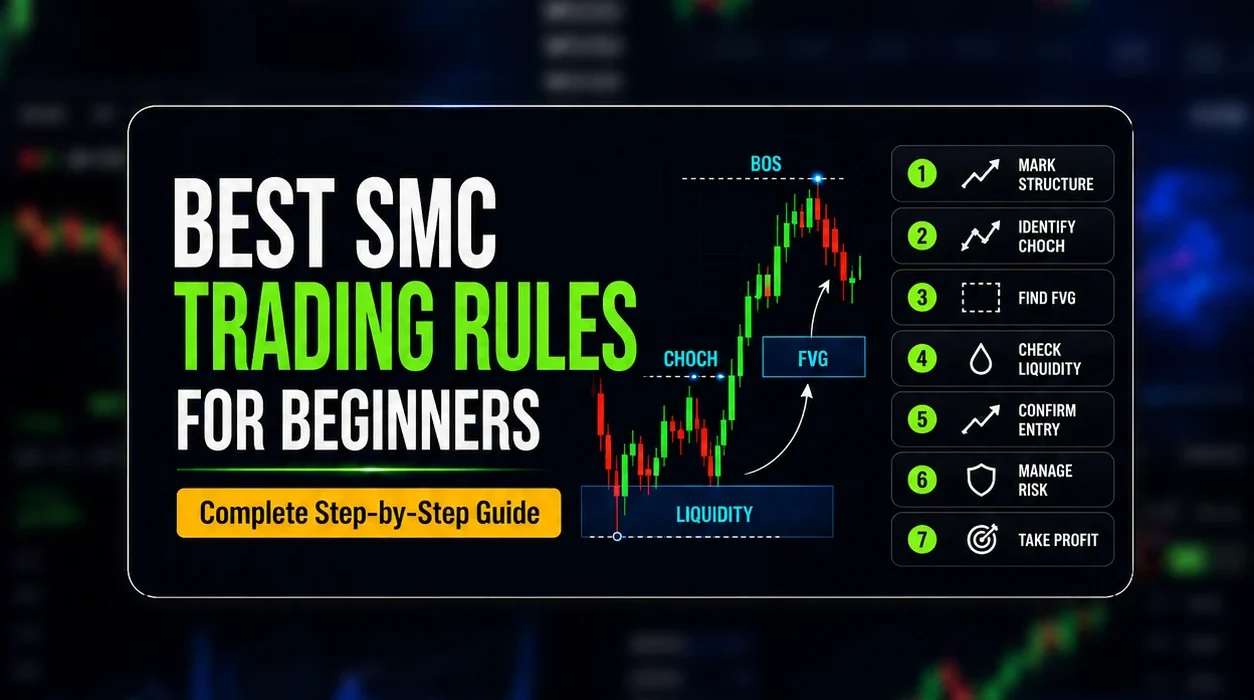
How to Practice SMC Trading on Charts for Beginners is one of the most important topics in Smart Money Concepts because learning SMC is not only about reading articles or watching videos. Real improvement happens when traders start applying the concepts directly on charts. Many beginners understand market structure, BOS, CHOCH, liquidity, order blocks, fair value gaps, premium and discount, multi timeframe analysis, entry strategy, risk management, psychology, trading plans, checklists, timing, market selection, journaling, and trading rules, but they still struggle because they do not know how to practice properly.
That is why learning How to Practice SMC Trading on Charts for Beginners matters so much. Chart practice is where concepts become skill. It trains the eye, improves patience, sharpens decision-making, and helps traders recognize repeating patterns in real market movement. Once you understand How to Practice SMC Trading on Charts for Beginners, you stop learning only in theory and start building real chart-reading ability.
What Is How to Practice SMC Trading on Charts for Beginners
How to Practice SMC Trading on Charts for Beginners means using live charts, replay charts, and historical market movement to repeatedly apply Smart Money Concepts until chart reading becomes more natural and more structured. It is not just about watching candles move. It is about actively marking, reviewing, and understanding why price moved the way it did.
A strong How to Practice SMC Trading on Charts for Beginners process usually includes:
- identifying higher timeframe bias
- marking structure
- locating liquidity
- waiting for the sweep
- spotting displacement
- marking BOS or CHOCH
- identifying order blocks or fair value gaps
- simulating entries and exits
- journaling the result
This is what makes How to Practice SMC Trading on Charts for Beginners such an important skill-building process.
Why How to Practice SMC Trading on Charts for Beginners Matters
How to Practice SMC Trading on Charts for Beginners matters because SMC concepts look very easy after the chart has already played out. On hindsight charts, everything looks obvious. But in real-time market conditions, the trader has to make decisions without knowing what comes next. That is where real practice becomes essential.
That is why How to Practice SMC Trading on Charts for Beginners helps traders:
- improve pattern recognition
- stop overthinking labels
- become more patient
- understand real market flow
- build confidence through repetition
- see the difference between theory and execution
Without learning How to Practice SMC Trading on Charts for Beginners, many traders stay stuck in passive learning and never develop real skill.
How to Practice SMC Trading on Charts for Beginners and the Right Mindset
How to Practice SMC Trading on Charts for Beginners starts with the right mindset. Practice should not be treated like gambling or random clicking. It should be treated like training. The goal is not to prove that you are right on every chart. The goal is to improve your ability to read and respond to price logically.
A healthy mindset for How to Practice SMC Trading on Charts for Beginners is:
- focus on process, not ego
- accept mistakes during practice
- keep chart reading simple
- repeat the same model many times
- aim for understanding before speed
This mindset makes How to Practice SMC Trading on Charts for Beginners far more effective because it keeps the focus on long-term learning.
How to Practice SMC Trading on Charts for Beginners and Choosing One Market
How to Practice SMC Trading on Charts for Beginners becomes much easier when you start with one market instead of many. Many beginners slow their learning by switching from forex to crypto to gold to indices every day. Each instrument has different behavior, and this creates confusion.
A smarter How to Practice SMC Trading on Charts for Beginners approach is:
- choose one market
- choose one or two instruments only
- watch how they move repeatedly
- study their session behavior
- build familiarity through repetition
This is one of the strongest ways to apply How to Practice SMC Trading on Charts for Beginners because repetition builds recognition.
How to Practice SMC Trading on Charts for Beginners and Using Chart Replay
How to Practice SMC Trading on Charts for Beginners becomes much more powerful when chart replay is used. Chart replay lets you hide future candles and study the market as if it is moving live. This is one of the best ways to develop real chart-reading skills.
In How to Practice SMC Trading on Charts for Beginners, chart replay helps you:
- remove hindsight bias
- practice real-time thinking
- test setup logic
- improve patience
- study confirmation properly
A strong How to Practice SMC Trading on Charts for Beginners routine is to pause the chart at important points and ask:
- what is the higher timeframe bias?
- where is liquidity?
- is this a sweep or just a move?
- did displacement happen?
- is BOS or CHOCH confirmed?
This turns replay into active learning.
How to Practice SMC Trading on Charts for Beginners and Marking Market Structure
How to Practice SMC Trading on Charts for Beginners should always begin with market structure. Before you mark order blocks or fair value gaps, you should first understand whether the market is bullish, bearish, or ranging.
In How to Practice SMC Trading on Charts for Beginners, structure practice means:
- mark swing highs
- mark swing lows
- identify higher highs and higher lows
- identify lower highs and lower lows
- separate continuation from possible reversal
This is one of the most important parts of How to Practice SMC Trading on Charts for Beginners because strong structure reading supports all other SMC concepts.
How to Practice SMC Trading on Charts for Beginners and Identifying Liquidity
How to Practice SMC Trading on Charts for Beginners also requires regular liquidity marking. SMC becomes much clearer when you learn to spot where stops are likely resting.
In How to Practice SMC Trading on Charts for Beginners, liquidity practice means:
- mark equal highs
- mark equal lows
- mark previous day high and low
- mark session highs and lows
- note obvious swing points
Then ask:
- did price attack this liquidity?
- did it reverse or continue after taking it?
- was there displacement afterward?
This is one of the most practical ways to improve How to Practice SMC Trading on Charts for Beginners.
How to Practice SMC Trading on Charts for Beginners and Watching the Sweep
How to Practice SMC Trading on Charts for Beginners becomes stronger when you focus on the liquidity sweep itself. Many beginners understand liquidity in theory, but they still struggle to read the actual moment when price takes it.
A useful How to Practice SMC Trading on Charts for Beginners exercise is:
- mark the liquidity pool
- replay the chart slowly
- watch how price approaches the level
- study how price behaves at the sweep
- see whether strong rejection or continuation follows
This helps traders stop predicting too early and start observing more accurately. That is why sweep observation is a key part of How to Practice SMC Trading on Charts for Beginners.
How to Practice SMC Trading on Charts for Beginners and Studying Displacement
How to Practice SMC Trading on Charts for Beginners also means learning to recognize displacement clearly. Many weak moves look exciting to beginners, but real displacement usually has more intent, stronger candles, and cleaner movement.
In How to Practice SMC Trading on Charts for Beginners, practice displacement by asking:
- did the market move strongly after the sweep?
- did the candles show intent?
- did imbalance appear?
- did price leave the zone with force?
This makes How to Practice SMC Trading on Charts for Beginners more refined because it helps separate weak reactions from higher-quality moves.
How to Practice SMC Trading on Charts for Beginners and BOS and CHOCH
How to Practice SMC Trading on Charts for Beginners should include repeated practice of BOS and CHOCH. These concepts become easier only when you label them many times on real charts.
A simple How to Practice SMC Trading on Charts for Beginners method is:
- mark the significant swing points
- wait for the liquidity event
- observe the reaction
- identify where CHOCH happens
- identify where BOS confirms continuation
Then review whether you marked them correctly. This makes How to Practice SMC Trading on Charts for Beginners much more interactive and skill-based.
How to Practice SMC Trading on Charts for Beginners and Order Blocks
How to Practice SMC Trading on Charts for Beginners also includes marking order blocks properly. But beginners should not mark every last candle before a move. That usually creates confusion.
A better How to Practice SMC Trading on Charts for Beginners exercise is:
- wait for liquidity sweep
- wait for displacement
- confirm structure shift
- then mark the order block created in that move
- replay price and see how it reacts if it returns
This helps beginners understand that order blocks are strongest when they have context.
How to Practice SMC Trading on Charts for Beginners and Fair Value Gaps
How to Practice SMC Trading on Charts for Beginners should also include fair value gap practice. After a strong move, identify whether an imbalance was created and whether price later returned into it.
A good How to Practice SMC Trading on Charts for Beginners routine is:
- find the impulsive move
- mark the FVG
- ask why it formed
- replay price forward
- observe whether price mitigates the gap
- check whether the reaction aligns with structure
This strengthens the trader’s understanding of how imbalance works in real conditions.
How to Practice SMC Trading on Charts for Beginners and Premium and Discount
How to Practice SMC Trading on Charts for Beginners becomes more advanced and more useful when you include premium and discount. This helps you understand whether your entry location is actually good inside the range.
Practice in How to Practice SMC Trading on Charts for Beginners by:
- marking the dealing range
- drawing the equilibrium
- identifying premium and discount
- checking whether bullish entries formed in discount
- checking whether bearish entries formed in premium
This improves location awareness and makes chart practice much more practical.
How to Practice SMC Trading on Charts for Beginners and Simulated Entries
How to Practice SMC Trading on Charts for Beginners should not stop at analysis. You should also simulate the actual trade. Once the setup appears, decide:
- where would I enter?
- where would my stop go?
- what is my target?
- what is the risk-to-reward?
- does the setup meet my rules?
This is one of the strongest parts of How to Practice SMC Trading on Charts for Beginners because it teaches execution, not just observation.
How to Practice SMC Trading on Charts for Beginners and Screenshot Review
How to Practice SMC Trading on Charts for Beginners becomes more effective when screenshots are used. After finishing the replay or the live observation, take screenshots and label:
- bias
- liquidity
- sweep
- BOS or CHOCH
- entry zone
- stop and target
Then review whether the setup actually made sense. Screenshot review is one of the easiest ways to improve How to Practice SMC Trading on Charts for Beginners because the visual feedback is very clear.
How to Practice SMC Trading on Charts for Beginners and Journaling Practice Sessions
How to Practice SMC Trading on Charts for Beginners becomes much stronger when practice sessions are journaled. You should not only journal real trades. You should also journal your practice analysis.
In How to Practice SMC Trading on Charts for Beginners, a simple practice journal can include:
- date
- market practiced
- setup type
- what was marked correctly
- what mistake happened
- one lesson learned
This turns every practice session into measurable progress.
How to Practice SMC Trading on Charts for Beginners and a Simple Daily Routine
A practical How to Practice SMC Trading on Charts for Beginners daily routine can look like this:
- Open one chart only
- Mark higher timeframe bias
- Mark key liquidity zones
- Replay the chart slowly
- Watch for sweep and displacement
- Mark BOS or CHOCH
- Mark order block or FVG
- Simulate entry, stop, and target
- Take screenshots
- Write one lesson in your journal
This simple routine is one of the best ways to build real chart skill.
Common Mistakes in How to Practice SMC Trading on Charts for Beginners
How to Practice SMC Trading on Charts for Beginners often becomes ineffective when beginners make common mistakes such as:
- switching too many markets
- watching charts passively instead of marking them
- using hindsight too much
- marking every candle as a zone
- skipping structure and focusing only on entries
- practicing without review
- not journaling lessons
The solution is simple. Keep How to Practice SMC Trading on Charts for Beginners focused, structured, and repetitive.
How to Practice SMC Trading on Charts for Beginners Conclusion
How to Practice SMC Trading on Charts for Beginners is one of the most important steps in becoming a skilled SMC trader because this is where chart theory becomes real pattern recognition. It teaches traders how to read structure, identify liquidity, wait for the sweep, confirm the move, and simulate entries with more clarity. Without practice, SMC stays theoretical. With regular chart practice, SMC becomes usable.
The biggest strength of How to Practice SMC Trading on Charts for Beginners is repetition. The more clean charts you study, the more natural structure, liquidity, BOS, CHOCH, order blocks, and fair value gaps become. If you truly want to improve in Smart Money Concepts, then consistent chart practice is one of the best things you can do.
How to Practice SMC Trading on Charts for Beginners FAQs
What is How to Practice SMC Trading on Charts for Beginners?
How to Practice SMC Trading on Charts for Beginners means using historical or replay charts to mark structure, liquidity, confirmation, and simulated entries in a structured way.
Why is How to Practice SMC Trading on Charts for Beginners important?
How to Practice SMC Trading on Charts for Beginners is important because it helps traders build real chart-reading skill instead of only learning theory.
Should I use chart replay to practice SMC?
Yes, chart replay is one of the best tools in How to Practice SMC Trading on Charts for Beginners because it removes hindsight bias and improves real-time decision-making.
How many markets should I practice at once?
For How to Practice SMC Trading on Charts for Beginners, it is usually better to practice one or two markets first so learning stays focused.
Should I journal my practice sessions too?
Yes, journaling is very useful in How to Practice SMC Trading on Charts for Beginners because it helps track mistakes, patterns, and lessons from practice.

A stock market enthusiast with hands-on experience in trading. He writes simple and practical content to help people understand the market better.


