


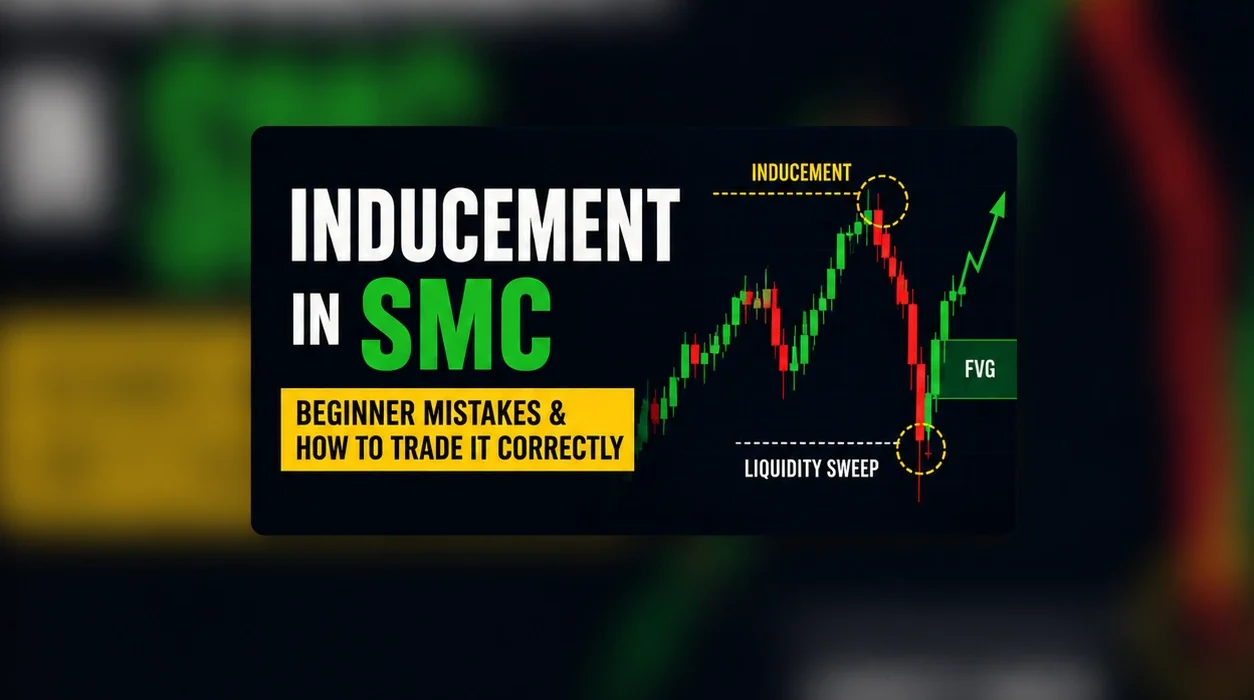
Inducement in SMC is one of the most misunderstood ideas in price-action trading. Beginners often label every false breakout or losing trade as inducement. In practice, the concept becomes useful only when combined with market structure, higher-timeframe direction, liquidity and confirmation.
What is Inducement in SMC?
Inducement is a move that encourages traders to enter too early or in the wrong direction. It may appear as a minor break of structure, trendline breakout, attractive pullback, support or resistance reaction, or a small swing high or low.
For example, price breaks above minor resistance and attracts breakout buyers. Their stops sit below the breakout or recent swing low. Price then fails to hold above resistance, reverses and moves towards those stops. The tempting breakout is the inducement, while the later move through clustered stops is the liquidity sweep. Traders may abbreviate inducement as IDM or IND.
Inducement is an interpretive framework, not proof that an institution deliberately targeted an individual trader.
Why Smart Money Creates Inducement
In the SMC model, large participants need sufficient opposing orders to enter or exit sizeable positions. Obvious chart patterns attract participation, while breakout and stop-loss orders create concentrations of executable orders.
Inducement explains a sequence in which price forms an appealing setup, attracts traders and then moves towards liquidity around their entries and stops. Common locations include equal highs, equal lows, previous swing points and obvious support or resistance.
However, not every reversal is planned manipulation. Markets move through combined order flow, positioning, volatility, news and available liquidity. Inducement is also easier to identify after the move has developed, so it should be treated as a probability-based concept.
Difference Between Liquidity and Inducement
Liquidity broadly means how easily an asset can be bought or sold without substantially affecting its price. In SMC language, traders also use “liquidity” for chart areas where orders may be clustered, such as above equal highs or below equal lows.
Inducement is the setup that attracts traders and helps create more orders. A breakout may induce buyers; their stops then add liquidity below. Inducement is the invitation, while the liquidity sweep is the later movement through the order cluster.
Sequence: Obvious setup → entry → clustered stops → liquidity sweep → reaction.
Best SMC Inducement Mistakes for Beginners
Trading Every Inducement
Marking every minor swing as a trap causes overtrading and hindsight bias. A useful setup should align with higher-timeframe direction, a meaningful liquidity target and a defined entry model.
Traders should avoid forcing an inducement setup simply because price has formed a small swing high, swing low or false breakout. Fewer high-quality setups are generally better than repeatedly entering weak patterns.
Ignoring Higher Timeframe Context
A one-minute bearish signal may be weak when the four-hour structure is bullish. Start with the daily or four-hour chart, identify the broader range and use lower timeframes mainly for execution.
For example, a bearish inducement setup forming inside a strong higher-timeframe demand zone may have limited downside potential. The lower-timeframe setup must support the broader market narrative.
Confusing Pullback with Inducement
Not every pullback is a trap. Trends naturally retrace before continuing. A pullback becomes possible inducement when it creates an obvious entry, builds vulnerable positioning and sits before a more important liquidity objective.
Beginners often assume that any retracement against the trend is inducement. Instead, study where the pullback occurs, which traders it attracts and whether a larger liquidity pool remains untouched.
Entering Before Confirmation
Entering immediately after a sweep is risky because price may continue. Wait for evidence such as displacement, a lower-timeframe structure shift, failed breakout, rejection from a key zone or a successful retest.
A liquidity sweep alone is not an automatic entry signal. Confirmation helps show that price has rejected the liquidity area and may be ready to move in the expected direction.
Ignoring Liquidity Sweep
An attractive level alone is insufficient. Ask which liquidity has been taken and which pool remains open. In a bullish setup, price may first sweep sell-side liquidity below a low before showing upward displacement.
Entering before the expected liquidity sweep can result in an otherwise correct analysis being stopped out before the actual move begins.
Wrong Stop Loss Placement
A stop should sit beyond the structural level that invalidates the idea, not at an arbitrary fixed distance. When the technical stop is wider, position size must be smaller.
Placing the stop directly below an obvious low or above an obvious high may leave it inside the liquidity area. At the same time, placing an extremely wide stop without reducing position size can create excessive account risk.
Poor Risk Management
Even a strong setup can fail. Define risk before entering and calculate size from the stop distance. CME presents the popular 2% rule as one possible framework but notes that the percentage is arbitrary and must suit the trader’s tolerance.
A trader should never increase position size merely because an inducement setup appears convincing. Every setup remains uncertain.
Real Chart Example
Imagine EUR/USD is bullish on the four-hour chart and approaching demand. On the 15-minute chart, price breaks below a minor low with a strong bearish candle. Breakout sellers enter and place stops above the recent swing high.
Price then sweeps sell-side liquidity below equal lows, rejects the demand zone and closes back above the broken minor low. A bullish displacement candle breaks the latest lower high.
The bearish breakdown acted as inducement, the equal lows were the liquidity target and displacement supplied confirmation.
A patient trader could wait for a retracement, place the stop beyond structural invalidation and target the next buy-side liquidity. The decision is based on context, sweep and confirmation—not the inducement label alone.
How to Trade Inducement Correctly
Begin with higher-timeframe bias. Mark major swing highs, swing lows, equal highs, equal lows and relevant supply or demand zones. Decide where price may seek liquidity before looking for an entry.
Identify the obvious setup attracting premature traders. Wait for price to sweep the relevant pool and observe the reaction. Confirmation may include displacement, a structure shift, rejection, failed breakout or controlled retest.
Enter only when the risk-to-reward relationship remains acceptable. Place the stop at the real invalidation point, size the position according to account risk and define the target before execution. Stops and position size should be planned together.
10-Step Inducement Checklist
- What is the daily or four-hour direction?
- Is price at a meaningful higher-timeframe location?
- Where are buy-side and sell-side liquidity?
- Which obvious setup is attracting traders?
- Has meaningful liquidity been swept?
- Did price reject or reclaim the level?
- Is there displacement or a structure shift?
- Is the entry based on a retest?
- Is the stop beyond structural invalidation?
- Are position size, target and maximum risk defined?
Conclusion
Inducement in SMC is not a magic reversal pattern. It helps traders understand how an obvious setup may attract participation before price reaches a more important liquidity target. Beginners should combine inducement with higher-timeframe context, liquidity mapping, confirmation and disciplined risk management.
Do not search for inducement everywhere. Wait for a clean sequence, accept that some setups will fail and evaluate the method through documented backtesting.
This article is educational and is not financial advice.
10 SEO FAQs
1. What is inducement in SMC trading?
It is a setup that attracts traders before price moves against them towards liquidity.
2. Is inducement the same as a liquidity sweep?
No. Inducement attracts entries, while a sweep moves through clustered orders or stop losses.
3. How do I identify inducement?
Look for an obvious setup before a larger liquidity pool, followed by rejection and market confirmation.
4. What is bullish inducement?
Bullish inducement occurs when price encourages selling before reversing upwards.
5. What is bearish inducement?
Bearish inducement occurs when price attracts buyers before reversing downwards.
6. Which timeframe is best for inducement trading?
Use higher timeframes for direction and important zones, and lower timeframes for entry confirmation.
7. Can inducement be traded without confirmation?
It can be traded without confirmation, but uncertainty and the probability of false signals are higher.
8. Where should the stop loss be placed?
The stop loss should be placed beyond the structural point that invalidates the trade idea.
9. Does inducement work in forex, crypto and stocks?
The concept can be studied across charted markets, although volatility, spreads and execution conditions differ.
10. Is SMC inducement profitable?
Not automatically. Results depend on backtesting, risk management, trading costs, execution quality and consistency.

A stock market enthusiast with hands-on experience in trading. He writes simple and practical content to help people understand the market better.


