


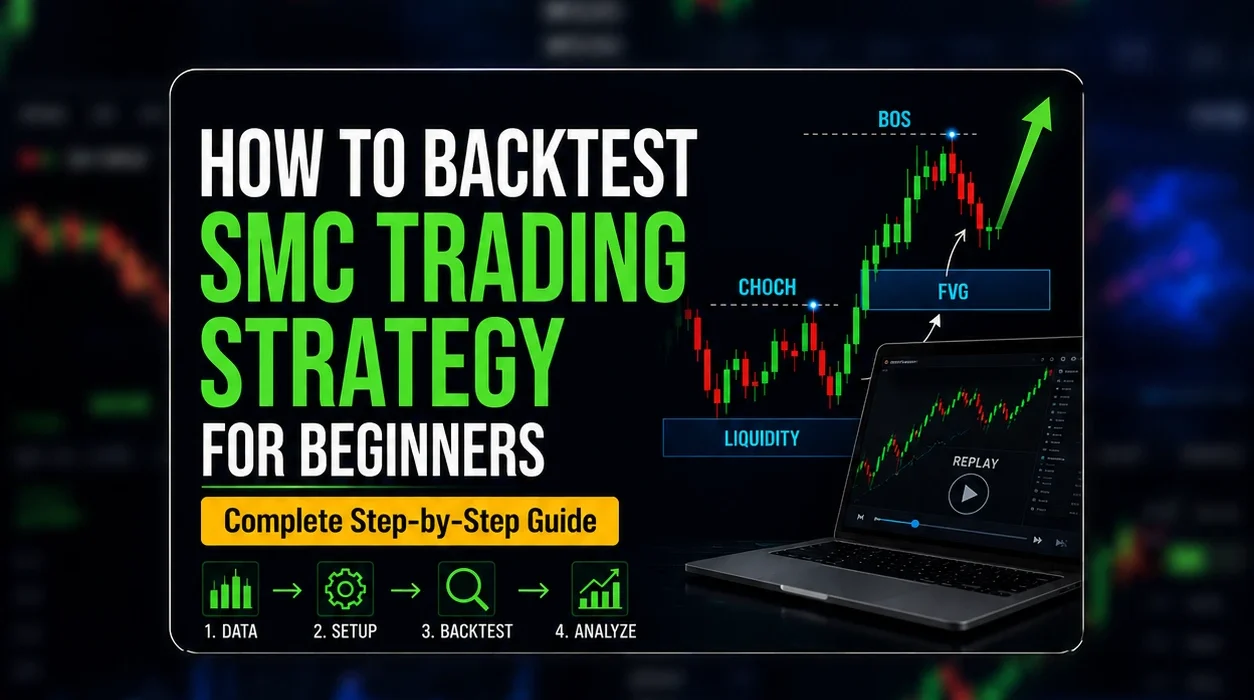
How to Backtest SMC Trading Strategy for Beginners is one of the most important topics in Smart Money Concepts because backtesting is where theory gets tested against real chart history. Many traders learn market structure, BOS, CHOCH, liquidity, order blocks, fair value gaps, premium and discount, multi timeframe analysis, entry strategy, risk management, psychology, trading plans, checklists, timing, market selection, journaling, trading rules, and chart practice, but they still struggle because they do not know how to test whether their strategy actually works.
That is why learning How to Backtest SMC Trading Strategy for Beginners matters so much. Backtesting helps traders see whether their setup has real consistency, whether their rules are clear enough, and whether their risk-to-reward and execution model make sense. Once you understand How to Backtest SMC Trading Strategy for Beginners, you stop relying only on opinion and start building confidence from evidence.
What Is How to Backtest SMC Trading Strategy for Beginners
How to Backtest SMC Trading Strategy for Beginners means using historical charts and replay tools to test an SMC setup according to fixed rules, then recording the results to see whether the setup performs well over time. It is not random chart watching. It is a structured testing process.
A proper How to Backtest SMC Trading Strategy for Beginners process usually includes:
- choosing one setup model
- defining exact entry rules
- defining exact stop loss rules
- defining exact take profit rules
- testing the setup on historical charts
- recording each result
- reviewing performance data
- refining the strategy only after enough samples
This is why How to Backtest SMC Trading Strategy for Beginners is so valuable. It turns a vague idea into a measurable method.
Why How to Backtest SMC Trading Strategy for Beginners Matters
How to Backtest SMC Trading Strategy for Beginners matters because many traders assume a setup works just because it looks good on a few charts. But a setup is not proven by one or two examples. It needs repeated testing across many chart conditions.
That is why How to Backtest SMC Trading Strategy for Beginners helps traders:
- test ideas with evidence
- avoid emotional assumptions
- understand win rate better
- understand drawdown better
- improve confidence in valid setups
- reject weak setups before risking real money
Without learning How to Backtest SMC Trading Strategy for Beginners, many traders confuse chart theory with actual performance.
How to Backtest SMC Trading Strategy for Beginners and the Goal of Backtesting
How to Backtest SMC Trading Strategy for Beginners starts with understanding the goal of backtesting. The goal is not to prove that your setup wins every time. The goal is to find out whether your setup has an edge when applied with discipline over many trades.
A good How to Backtest SMC Trading Strategy for Beginners mindset is:
- I am testing a process, not chasing perfection
- I want data, not guesswork
- I want to know what happens over 20, 50, or 100 trades
- I want to see both strengths and weaknesses clearly
This mindset makes How to Backtest SMC Trading Strategy for Beginners much more effective because it keeps the focus on consistency rather than ego.
How to Backtest SMC Trading Strategy for Beginners and Choosing One Setup
How to Backtest SMC Trading Strategy for Beginners becomes much easier when you test only one setup at a time. Many beginners make the mistake of mixing too many ideas together. Then they cannot tell what is actually working.
A smarter How to Backtest SMC Trading Strategy for Beginners approach is to choose one model such as:
- liquidity sweep plus BOS entry
- CHOCH plus order block retest
- fair value gap continuation setup
- premium-discount reversal setup
- multi timeframe confluence setup
This is one of the strongest rules in How to Backtest SMC Trading Strategy for Beginners because single-setup testing creates clear data.
How to Backtest SMC Trading Strategy for Beginners and Defining Exact Rules
How to Backtest SMC Trading Strategy for Beginners must include exact rules before testing begins. If the rules keep changing during the backtest, then the results become unreliable.
In How to Backtest SMC Trading Strategy for Beginners, define:
- what counts as higher timeframe bias
- what counts as liquidity
- what counts as displacement
- what counts as BOS or CHOCH
- which order block or FVG is valid
- where entry happens
- where stop loss goes
- where take profit goes
- when the setup is invalid
This is one of the most important parts of How to Backtest SMC Trading Strategy for Beginners because unclear rules create fake confidence.
How to Backtest SMC Trading Strategy for Beginners and Picking the Right Market
How to Backtest SMC Trading Strategy for Beginners also requires choosing one market first. If you test too many markets together, the data becomes harder to interpret.
A strong How to Backtest SMC Trading Strategy for Beginners plan is:
- choose one instrument
- test one session behavior
- use one market condition first
- gather clean data before expanding
For example, you may test one forex pair, one index, or one gold setup only. This keeps How to Backtest SMC Trading Strategy for Beginners focused and practical.
How to Backtest SMC Trading Strategy for Beginners and Using Chart Replay
How to Backtest SMC Trading Strategy for Beginners becomes much better when chart replay is used. Replay removes hindsight bias and helps the trader think like the market is live.
In How to Backtest SMC Trading Strategy for Beginners, chart replay helps because:
- future candles stay hidden
- decisions must be made step by step
- the trader cannot cheat by seeing the result early
- entry and exit logic become more realistic
This makes How to Backtest SMC Trading Strategy for Beginners far more useful than simply scrolling through finished charts and choosing only good-looking examples.
How to Backtest SMC Trading Strategy for Beginners and Testing Higher Timeframe Bias
How to Backtest SMC Trading Strategy for Beginners should begin every test with higher timeframe bias. Before looking for entries, record the larger direction of the market.
A strong How to Backtest SMC Trading Strategy for Beginners process may include:
- mark higher timeframe bullish, bearish, or range
- note whether price is in premium or discount
- mark major liquidity zones
- only test entries aligned with your bias rule
This helps keep How to Backtest SMC Trading Strategy for Beginners realistic and consistent with SMC logic.
How to Backtest SMC Trading Strategy for Beginners and Marking Liquidity
How to Backtest SMC Trading Strategy for Beginners also includes liquidity marking. Since SMC depends heavily on liquidity, your backtest should record whether the trade setup came after a meaningful liquidity event.
In How to Backtest SMC Trading Strategy for Beginners, record:
- was buy-side liquidity present?
- was sell-side liquidity present?
- did price actually sweep it?
- was the sweep clear or weak?
- did the sweep align with the setup model?
This makes the backtest more precise and helps you understand whether liquidity-based trades are truly giving an edge.
How to Backtest SMC Trading Strategy for Beginners and Entry Logic
How to Backtest SMC Trading Strategy for Beginners must use consistent entry logic. If you enter differently every time, then your test results cannot be trusted.
A clear How to Backtest SMC Trading Strategy for Beginners entry model may be:
- after liquidity sweep
- after displacement
- after BOS or CHOCH
- enter on order block retest
- or enter on fair value gap mitigation
- only after confirmation if your model requires it
This is what makes How to Backtest SMC Trading Strategy for Beginners measurable instead of random.
How to Backtest SMC Trading Strategy for Beginners and Stop Loss Placement
How to Backtest SMC Trading Strategy for Beginners should always include fixed stop loss logic. Stop placement must follow the same rule every time unless the strategy itself has defined alternatives.
In How to Backtest SMC Trading Strategy for Beginners, stop loss may be placed:
- below the sweep low in bullish setups
- above the sweep high in bearish setups
- below the order block
- above the invalidation point
- below or above the confirmation candle structure
This is one of the most practical parts of How to Backtest SMC Trading Strategy for Beginners because bad stop logic can make a good idea look bad.
How to Backtest SMC Trading Strategy for Beginners and Take Profit Rules
How to Backtest SMC Trading Strategy for Beginners also needs consistent take profit rules. If you change targets randomly, the backtest becomes unreliable.
A good How to Backtest SMC Trading Strategy for Beginners model may use:
- fixed 1:2 reward-to-risk
- fixed 1:3 reward-to-risk
- previous high or low
- opposite liquidity pool
- partial at first target and rest at second target
The important thing is consistency. That is what gives How to Backtest SMC Trading Strategy for Beginners real value.
How to Backtest SMC Trading Strategy for Beginners and Recording Results
How to Backtest SMC Trading Strategy for Beginners becomes meaningful only when every test trade is recorded properly. You should note:
- date
- market
- timeframe
- setup type
- entry
- stop
- target
- result
- reward-to-risk outcome
- screenshot
- comment or mistake note
This turns How to Backtest SMC Trading Strategy for Beginners into real data collection rather than casual observation.
How to Backtest SMC Trading Strategy for Beginners and Important Metrics
How to Backtest SMC Trading Strategy for Beginners becomes more useful when key performance metrics are tracked. Beginners often focus only on win rate, but win rate alone is not enough.
Important metrics in How to Backtest SMC Trading Strategy for Beginners include:
- total number of trades
- win rate
- loss rate
- average reward-to-risk
- longest losing streak
- best-performing setup condition
- worst-performing setup condition
- session performance
- direction performance
These metrics help you see the real strength of a strategy.
How to Backtest SMC Trading Strategy for Beginners and Sample Size
How to Backtest SMC Trading Strategy for Beginners should always use a good sample size. Testing just five or ten trades is usually not enough to judge a strategy properly.
A better How to Backtest SMC Trading Strategy for Beginners approach is:
- test at least 20 trades for early insight
- test 50 trades for better confidence
- test 100 trades for stronger evidence
This is important because a few wins or losses do not tell the full story. Sample size gives How to Backtest SMC Trading Strategy for Beginners more reliability.
How to Backtest SMC Trading Strategy for Beginners and Avoiding Bias
How to Backtest SMC Trading Strategy for Beginners also means avoiding bias during testing. Common backtesting mistakes include:
- only selecting perfect-looking setups
- skipping losing examples
- changing rules midway
- entering with hindsight
- moving stop or target after seeing the result
A clean How to Backtest SMC Trading Strategy for Beginners process should stay honest. If the setup does not meet the rules, skip it. If it meets the rules and loses, record it honestly.
How to Backtest SMC Trading Strategy for Beginners and Reviewing the Data
How to Backtest SMC Trading Strategy for Beginners should end with proper review. After enough trades are recorded, ask:
- does the setup really have an edge?
- which conditions improve its performance?
- which conditions weaken it?
- is the win rate acceptable with the reward-to-risk?
- is the drawdown manageable?
- should anything be refined?
This review stage is what makes How to Backtest SMC Trading Strategy for Beginners so powerful. It turns results into strategy improvement.
How to Backtest SMC Trading Strategy for Beginners and a Simple Backtesting Workflow
A simple How to Backtest SMC Trading Strategy for Beginners workflow can look like this:
- Choose one market
- Choose one SMC setup
- Define clear rules
- Open chart replay
- Mark higher timeframe bias
- Mark liquidity and structure
- Wait for the setup to form
- Simulate entry, stop, and target
- Record the result
- Repeat for 20 to 100 trades
- Review the data honestly
This is one of the most practical ways to apply How to Backtest SMC Trading Strategy for Beginners.
Common Mistakes in How to Backtest SMC Trading Strategy for Beginners
How to Backtest SMC Trading Strategy for Beginners often fails because beginners make common mistakes such as:
- testing too many setups at once
- using unclear rules
- changing rules mid-test
- focusing only on win rate
- using too few trades
- skipping journaling
- letting hindsight influence entries
- refusing to record bad results honestly
The solution is to keep How to Backtest SMC Trading Strategy for Beginners simple, rule-based, and data-driven.
How to Backtest SMC Trading Strategy for Beginners Conclusion
How to Backtest SMC Trading Strategy for Beginners is one of the most important steps in building confidence as an SMC trader because it replaces assumptions with evidence. It helps traders understand whether a setup truly works, under what conditions it performs best, and whether the rules are strong enough to follow in real markets. Without backtesting, strategy confidence stays weak. With backtesting, confidence becomes much more grounded.
The biggest strength of How to Backtest SMC Trading Strategy for Beginners is clarity. It shows what actually works, what needs refinement, and what should be avoided. If you truly want to improve in Smart Money Concepts, then learning How to Backtest SMC Trading Strategy for Beginners is essential because backtesting is where a setup starts becoming a real trading system.
How to Backtest SMC Trading Strategy for Beginners FAQs
What is How to Backtest SMC Trading Strategy for Beginners?
How to Backtest SMC Trading Strategy for Beginners means testing an SMC setup on historical charts using fixed entry, stop, and target rules to measure real performance.
Why is How to Backtest SMC Trading Strategy for Beginners important?
How to Backtest SMC Trading Strategy for Beginners is important because it helps traders verify whether a setup has an edge before risking real money.
Should I use chart replay for backtesting?
Yes, chart replay is one of the best tools in How to Backtest SMC Trading Strategy for Beginners because it reduces hindsight bias and makes testing more realistic.
How many trades should I backtest?
In How to Backtest SMC Trading Strategy for Beginners, 20 trades can give early insight, but 50 to 100 trades usually provide stronger evidence.
What should I record during backtesting?
A good How to Backtest SMC Trading Strategy for Beginners process records market, timeframe, setup, entry, stop, target, result, screenshot, and lesson from the trade.

A stock market enthusiast with hands-on experience in trading. He writes simple and practical content to help people understand the market better.


