


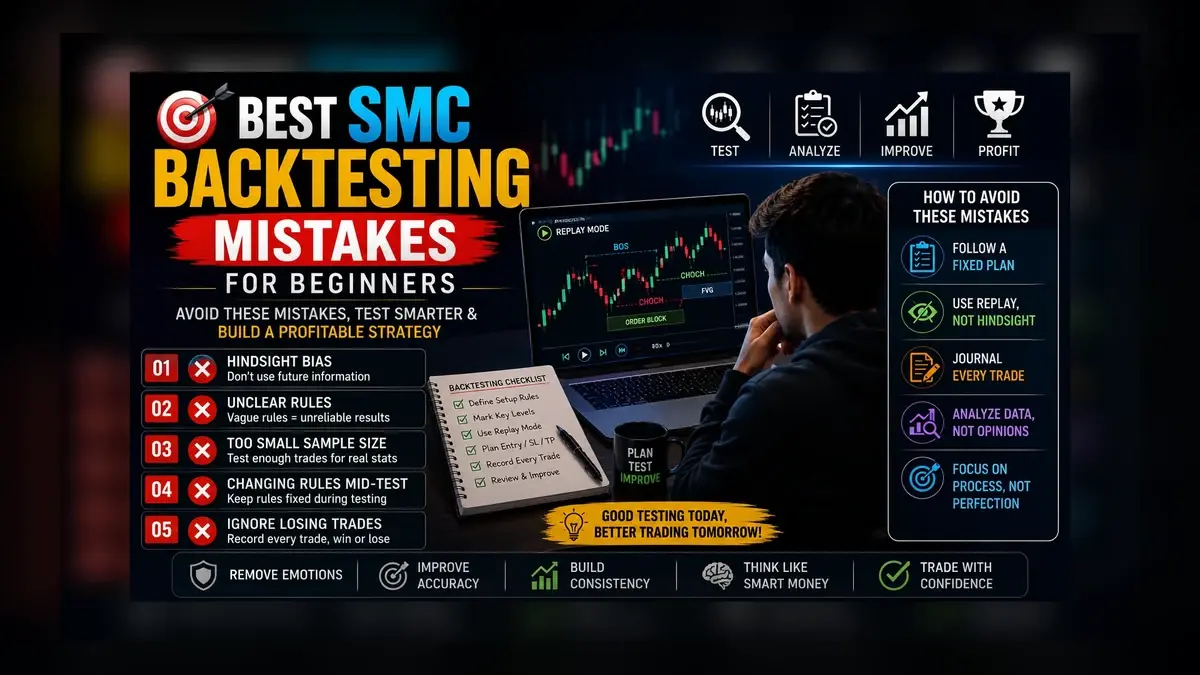
Common Mistakes in SMC Trading is one of the most important topics for every beginner because many traders learn the concepts but still lose money due to poor execution. A trader may understand market structure, BOS, CHOCH, liquidity, order blocks, fair value gaps, premium and discount, multi timeframe analysis, and even entry strategy, but without avoiding Common Mistakes in SMC Trading, the results often remain inconsistent.
The problem is simple. Most beginners focus too much on learning labels and too little on learning discipline, context, and patience. That is why Common Mistakes in SMC Trading should be studied seriously. It helps traders understand not only what to do, but also what not to do. Once you know the biggest errors, you can protect your account, improve your decision-making, and make SMC far more practical.
What Are Common Mistakes in SMC Trading
Common Mistakes in SMC Trading means the repeated errors traders make while applying Smart Money Concepts. These mistakes usually happen when traders understand the theory only partially or use SMC in a rushed and mechanical way.
Some traders mark every candle as an order block. Some treat every structure break as BOS or CHOCH. Some assume every liquidity sweep must reverse. Some ignore higher timeframe bias completely. These are all Common Mistakes in SMC Trading that cause confusion and low-quality trades.
The biggest issue is that SMC looks easy on hindsight charts. But in live markets, discipline matters more than labels. That is why studying Common Mistakes in SMC Trading can improve real results more than simply learning new concepts.
Why Common Mistakes in SMC Trading Matter
Common Mistakes in SMC Trading matter because they often damage confidence, capital, and consistency. Many traders blame the strategy, but the real issue is usually poor application. SMC itself is a framework, not a magic formula. If the framework is used without patience, context, and risk control, losses become common.
Understanding Common Mistakes in SMC Trading helps traders:
- avoid weak setups
- reduce emotional entries
- improve trade quality
- protect account capital
- stay patient
- build long-term consistency
A trader who avoids the main Common Mistakes in SMC Trading often improves faster than a trader who keeps learning new concepts without fixing old errors.
Common Mistakes in SMC Trading and Ignoring Higher Timeframe Bias
One of the biggest Common Mistakes in SMC Trading is ignoring higher timeframe bias. Many beginners see a nice order block or fair value gap on a lower timeframe and enter immediately without checking the bigger market direction.
This creates a major problem. A bullish 5-minute setup may only be a weak pullback inside a strong bearish higher timeframe trend. A bearish 15-minute setup may fail quickly if the daily chart is strongly bullish. That is why ignoring higher timeframe structure is one of the most dangerous Common Mistakes in SMC Trading.
The simple fix is:
- first check the higher timeframe
- identify trend or range
- mark major liquidity
- then move to the lower timeframe for entry
This one habit reduces many Common Mistakes in SMC Trading immediately.
Common Mistakes in SMC Trading and Marking Too Many Zones
Another major issue in Common Mistakes in SMC Trading is overmarking the chart. Many beginners mark every order block, every fair value gap, every small liquidity pool, and every swing. The result is a messy chart with too much noise.
SMC works best when the chart is clean and selective. One of the most practical lessons in avoiding Common Mistakes in SMC Trading is learning that not every zone matters. Strong zones usually come after:
- liquidity sweep
- displacement
- structure shift
- higher timeframe alignment
If you mark everything, then nothing looks special. That is why overmarking is one of the most common Common Mistakes in SMC Trading.
Common Mistakes in SMC Trading and Using SMC Without Structure
Common Mistakes in SMC Trading often happen when traders focus on order blocks and FVGs without understanding market structure first. A bullish order block in clear bearish structure is weaker. A bearish FVG in strong bullish continuation may fail. A liquidity sweep without structure context may mislead.
This is why one of the key Common Mistakes in SMC Trading is putting zones before structure. The correct sequence should usually be:
- identify structure
- identify liquidity
- wait for sweep
- wait for displacement
- then mark the zone
This keeps SMC logical. Structure should guide the analysis, not random zones.
Common Mistakes in SMC Trading and Misreading BOS and CHOCH
Common Mistakes in SMC Trading also include misreading BOS and CHOCH. Many beginners call every small break BOS. Others call every pullback CHOCH. This creates confusion because structure loses meaning.
BOS usually confirms continuation. CHOCH usually suggests possible shift. But in Common Mistakes in SMC Trading, traders often forget that timeframe and context matter. A lower timeframe CHOCH may only be a retracement inside a higher timeframe trend. A weak wick beyond a high may not be a true BOS.
The fix for this type of Common Mistakes in SMC Trading is simple:
- mark only meaningful swing points
- use clean structure
- compare internal and external structure
- do not label every tiny break
This improves clarity immediately.
Common Mistakes in SMC Trading and Treating Every Liquidity Sweep as Reversal
One of the most repeated Common Mistakes in SMC Trading is assuming every liquidity sweep must cause reversal. Traders learn that smart money takes liquidity, so they start fading every sweep without confirmation.
But this is not how SMC works. In many cases, price takes liquidity and continues in the same direction. In other cases, it reverses. The key is what happens after the sweep. That is why one of the most important lessons in avoiding Common Mistakes in SMC Trading is this: liquidity sweep alone is not enough.
After a sweep, you still need:
- displacement
- CHOCH or BOS
- structure confirmation
- zone alignment
- stronger context
This is how you reduce one of the biggest Common Mistakes in SMC Trading.
Common Mistakes in SMC Trading and Entering Without Confirmation
Common Mistakes in SMC Trading often happen because beginners enter at first touch without confirmation. They see an order block or FVG and place a trade immediately, even though price has not shown any real reaction yet.
This is risky because zones can fail. A strong Common Mistakes in SMC Trading fix is to wait for confirmation such as:
- lower timeframe CHOCH
- lower timeframe BOS
- rejection candle
- momentum candle
- clear reaction from the zone
For beginners especially, waiting for confirmation reduces unnecessary losses. Entering blindly is one of the most expensive Common Mistakes in SMC Trading.
Common Mistakes in SMC Trading and Chasing Price After Displacement
Another problem in Common Mistakes in SMC Trading is chasing price after a strong move. Traders see displacement and enter too late because they fear missing the move. But by that time, the stop becomes wider and the reward becomes smaller.
Good SMC usually waits for price to retrace into a cleaner area such as:
- order block
- fair value gap
- discount in bullish setup
- premium in bearish setup
Chasing price is one of the most emotional Common Mistakes in SMC Trading. The better habit is patience. Let price come back if the setup is truly strong.
Common Mistakes in SMC Trading and Ignoring Premium and Discount
Common Mistakes in SMC Trading also include poor entry location. Some traders buy in premium in a bullish market after price already moved heavily. Others sell in discount in a bearish market after price already dropped too much. Even if the idea is right, the location is poor.
That is why ignoring premium and discount is one of the practical Common Mistakes in SMC Trading. A trader should always ask:
- is price expensive or cheap inside the range?
- am I buying too high?
- am I selling too low?
Good entry location improves risk-to-reward. Bad location increases stress and weakens the setup.
Common Mistakes in SMC Trading and Poor Risk Management
One of the biggest Common Mistakes in SMC Trading has nothing to do with analysis. It is poor risk management. Many traders risk too much on one trade because they feel the setup is “perfect.” Others move stop loss emotionally. Some revenge trade after one loss.
Even if your analysis is good, poor risk management can destroy results. This is why Common Mistakes in SMC Trading must include:
- risking too much per trade
- no daily loss limit
- random stop placement
- overtrading
- increasing size after a loss
The fix is simple:
- use fixed risk per trade
- place stop at invalidation
- stop after defined losses
- protect capital first
Avoiding these Common Mistakes in SMC Trading is essential for survival.
Common Mistakes in SMC Trading and Overtrading
Common Mistakes in SMC Trading often get worse because of overtrading. Some traders feel they must trade every session, every chart, or every setup. This creates low-quality entries and emotional pressure.
SMC is actually a patient framework. It often requires waiting for liquidity, sweep, confirmation, and retest. When traders force activity, they break the core logic of SMC. That is why overtrading is one of the most damaging Common Mistakes in SMC Trading.
The better approach is:
- trade fewer setups
- focus on clean alignment
- avoid boredom trades
- skip unclear charts
Sometimes the best way to avoid Common Mistakes in SMC Trading is to simply not trade.
Common Mistakes in SMC Trading and Using Too Many Timeframes
Common Mistakes in SMC Trading also happen when traders use too many timeframes at once. They check daily, 4-hour, 1-hour, 15-minute, 5-minute, 1-minute, and then become confused because each chart looks different.
Too much analysis creates paralysis. In Common Mistakes in SMC Trading, this usually leads to hesitation, emotional entries, or forcing alignment where none exists.
A simpler approach is better:
- one higher timeframe for bias
- one middle timeframe for setup
- one lower timeframe for entry
This keeps SMC practical and reduces confusion.
Common Mistakes in SMC Trading and Psychology Issues
Common Mistakes in SMC Trading are not only technical. Many are psychological. Traders fear missing out, panic after losses, close trades too early, or hold losers too long. These emotional problems make even good analysis ineffective.
That is why one of the deepest Common Mistakes in SMC Trading is lack of discipline. A trader must accept:
- not every setup is valid
- losses are normal
- no setup is guaranteed
- patience is part of the strategy
- consistency matters more than excitement
Strong psychology helps avoid many Common Mistakes in SMC Trading even before they happen.
Common Mistakes in SMC Trading and Not Journaling
A very underrated part of Common Mistakes in SMC Trading is failing to review your own trades. Many traders repeat the same mistakes because they never document them. Without review, improvement becomes very slow.
A journal can help track:
- higher timeframe bias
- liquidity sweep
- entry reason
- stop placement
- result
- emotional mistakes
- lessons learned
This is one of the best ways to fix Common Mistakes in SMC Trading over time. When you write it down, patterns become visible.
How to Avoid Common Mistakes in SMC Trading
The best way to reduce Common Mistakes in SMC Trading is to simplify the process. Use a repeatable checklist before every trade:
- Is higher timeframe bias clear?
- Is structure clean?
- Was liquidity taken?
- Is there displacement?
- Did BOS or CHOCH confirm?
- Is the zone valid?
- Is entry location good?
- Is risk controlled?
- Is the reward worth it?
- Am I calm enough to take this trade?
This checklist helps avoid many Common Mistakes in SMC Trading before the trade even happens.
Conclusion
Common Mistakes in SMC Trading are a major reason why beginners struggle even after learning the concepts. The issue is not always lack of knowledge. Very often, the issue is overcomplication, impatience, poor context, or bad risk management. That is why understanding Common Mistakes in SMC Trading can improve performance faster than learning new labels.
The real goal is not to make SMC look advanced. The real goal is to make it practical. If you focus on structure, liquidity, confirmation, patience, and disciplined execution, you can avoid most Common Mistakes in SMC Trading and trade with much more confidence and clarity.
FAQs
What are the most common mistakes in SMC Trading?
The most common mistakes in Common Mistakes in SMC Trading include ignoring higher timeframe bias, entering without confirmation, overmarking zones, poor risk management, and overtrading.
Why do beginners struggle with Common Mistakes in SMC Trading?
Beginners struggle with Common Mistakes in SMC Trading because they often focus more on labels and less on context, patience, and discipline.
Is every liquidity sweep a reversal in SMC Trading?
No. One of the biggest Common Mistakes in SMC Trading is assuming every liquidity sweep will reverse. Confirmation is still needed.
How do I avoid Common Mistakes in SMC Trading?
You can avoid Common Mistakes in SMC Trading by using higher timeframe bias, waiting for confirmation, controlling risk, and journaling your trades.
Can risk management solve Common Mistakes in SMC Trading?
Risk management cannot solve everything, but it reduces the damage from many Common Mistakes in SMC Trading and helps protect the account while you improve.

A stock market enthusiast with hands-on experience in trading. He writes simple and practical content to help people understand the market better.


