


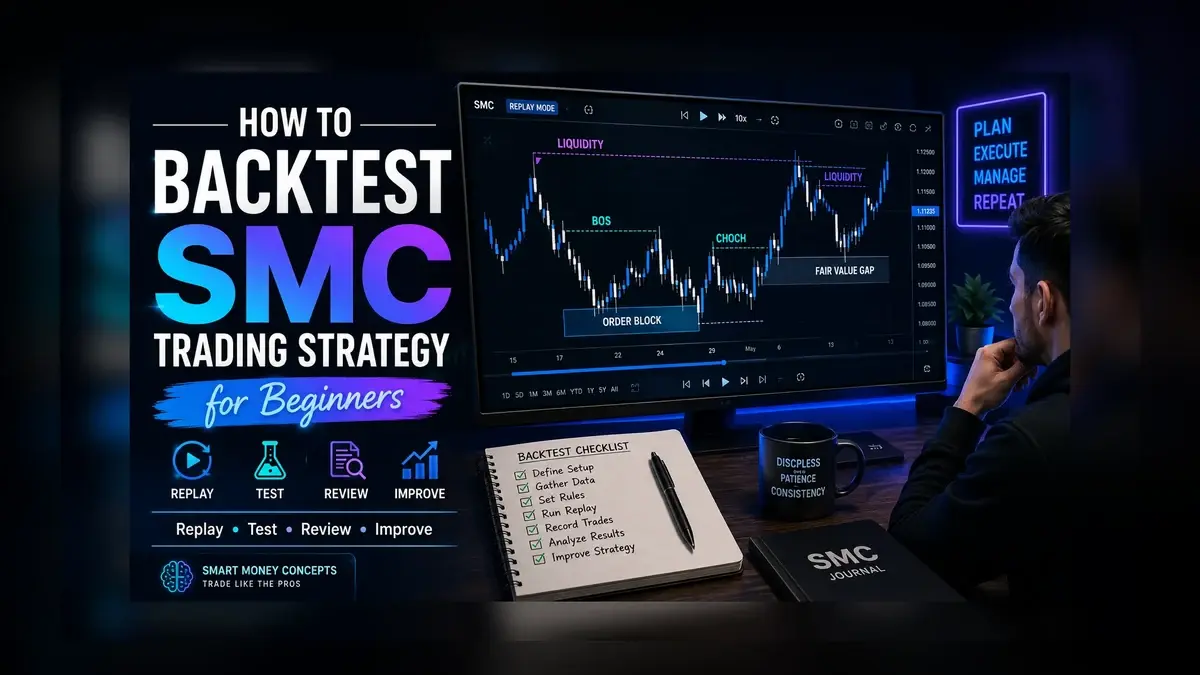
Risk Management in SMC Trading is one of the most important topics in Smart Money Concepts because even the best setup can fail. A trader may understand market structure, liquidity, BOS, CHOCH, order blocks, fair value gaps, premium and discount, and multi timeframe analysis, but without proper Risk Management in SMC Trading, one bad trade or one emotional decision can damage the account badly.
Many beginners think the secret to success is only finding perfect entries. But the truth is different. The real difference between profitable traders and struggling traders often comes from Risk Management in SMC Trading. Good risk management protects your capital, controls losses, reduces emotional pressure, and allows you to survive long enough to improve. That is why Risk Management in SMC Trading is not optional. It is the base that keeps every strategy alive.
What Is Risk Management in SMC Trading
Risk Management in SMC Trading means controlling how much money you are willing to lose on each trade and how you manage your capital over time. It is the system that protects you when the market does not behave as expected. In simple words, Risk Management in SMC Trading is about staying safe first and making money second.
A proper Risk Management in SMC Trading plan usually includes:
- fixed risk per trade
- stop loss placement
- position sizing
- risk-to-reward planning
- daily loss limits
- drawdown control
- emotional discipline
- trade selection rules
This is what makes Risk Management in SMC Trading so powerful. It gives a trader structure even when the market becomes unpredictable.
Why Risk Management in SMC Trading Matters
Risk Management in SMC Trading matters because no setup wins all the time. Even high-probability SMC setups can fail due to sudden volatility, news, poor execution, or misread context. If a trader risks too much on one trade, then one losing trade can create unnecessary damage.
That is why Risk Management in SMC Trading helps traders:
- protect account capital
- reduce emotional trading
- survive losing streaks
- stay consistent
- avoid revenge trading
- trade with a clear mind
A trader with average entries and strong Risk Management in SMC Trading often survives longer than a trader with strong entries but no discipline. This is the real reason risk management is so important.
Risk Management in SMC Trading and Capital Protection
Risk Management in SMC Trading begins with capital protection. Your first job as a trader is not to double your money quickly. Your first job is to protect what you already have. If your capital is safe, you can continue trading and improving. If your capital is destroyed, the journey ends early.
In Risk Management in SMC Trading, capital protection means:
- never risking too much on one trade
- avoiding overtrading
- stopping after heavy losses
- taking only quality setups
- accepting that losses are normal
This mindset is very important. Traders who focus only on fast profit usually ignore Risk Management in SMC Trading, and that often leads to account blowups.
Risk Management in SMC Trading and Risk Per Trade
Risk Management in SMC Trading becomes practical when you decide how much to risk per trade. One of the most common rules is risking a fixed percentage of your account on each setup. Many traders risk 1% or less. Some very conservative traders risk 0.5%.
For example, if your account is ₹10,000 and you risk 1% per trade, then the maximum you should lose on that trade is ₹100. This is one of the most basic and powerful parts of Risk Management in SMC Trading.
The benefit of fixed risk is simple. It keeps losses controlled. Even if you lose multiple trades, your account remains manageable. That is why Risk Management in SMC Trading is about consistency, not excitement.
Risk Management in SMC Trading and Position Sizing
Risk Management in SMC Trading is closely connected with position sizing. Position size should not be random. It should be based on:
- account size
- risk per trade
- stop loss distance
- market conditions
This means in Risk Management in SMC Trading, you do not use the same lot size for every trade. If your stop loss is wider, your position size should be smaller. If your stop loss is tighter, your position size may be slightly larger while still keeping the same total risk.
This is a very important point because many beginners break Risk Management in SMC Trading by doing the opposite. They choose lot size first and then place stop loss later. The correct process is:
- decide account risk
- decide stop loss location
- calculate position size
That is proper Risk Management in SMC Trading.
Risk Management in SMC Trading and Stop Loss Placement
Risk Management in SMC Trading requires logical stop loss placement. A stop loss should be placed where the trade idea becomes invalid, not where the trader feels comfortable emotionally. In SMC, stop loss is often placed beyond:
- swept high or low
- order block boundary
- structure invalidation point
- confirmation candle low or high
For bullish setups, Risk Management in SMC Trading often places stop loss below the key low that supports the setup. For bearish setups, the stop loss is usually above the key high. This makes the trade logical and measurable.
A random stop loss breaks Risk Management in SMC Trading because it creates inconsistency. Some stops are too small and get hit by noise. Others are too wide and damage reward-to-risk. Good stop loss logic is essential.
Risk Management in SMC Trading and Risk-to-Reward Ratio
Risk Management in SMC Trading also includes understanding risk-to-reward ratio. Risk-to-reward means how much you are risking compared to how much you could potentially make. For example:
- risk ₹100 to make ₹200 = 1:2
- risk ₹100 to make ₹300 = 1:3
A strong Risk Management in SMC Trading plan often prefers setups with reasonable reward relative to risk. This does not mean every trade must have huge targets. It means the trade should make sense. If the target is too close and the stop is too wide, the trade may not be worth taking.
This is why Risk Management in SMC Trading improves not only protection but also setup quality. It forces traders to ask:
- Is this trade worth the risk?
- Is the target realistic?
- Is the setup clean enough?
These questions remove many weak trades.
Risk Management in SMC Trading and Losing Streaks
Risk Management in SMC Trading becomes especially important during losing streaks. Every trader goes through losing periods. The difference is how they respond. Traders without discipline often increase lot size, revenge trade, or ignore rules. That is where real damage happens.
A proper Risk Management in SMC Trading approach during losing streaks may include:
- reducing risk temporarily
- stopping for the day after a set number of losses
- reviewing mistakes
- trading fewer setups
- waiting for high-conviction opportunities
This is very important because losing streaks are part of trading. Strong Risk Management in SMC Trading keeps a losing streak from turning into a disaster.
Risk Management in SMC Trading and Daily Loss Limit
Risk Management in SMC Trading also includes daily loss limits. A daily loss limit means deciding in advance how much you are willing to lose in one day before you stop trading. This could be 2% or 3% of the account, depending on the trader’s style.
This rule helps because after multiple losses, emotional pressure rises. Decision-making becomes weak. A daily loss limit protects the trader from spiraling into revenge trading. That is why many professionals treat Risk Management in SMC Trading as a daily process, not only a per-trade process.
A simple rule for Risk Management in SMC Trading can be:
- maximum 2 losing trades per day
- or maximum 2% daily drawdown
- once hit, stop trading and review
This rule alone can save many beginners from unnecessary account damage.
Risk Management in SMC Trading and Drawdown Control
Risk Management in SMC Trading also means controlling drawdown. Drawdown is the drop from your account peak to your current balance. Every trader experiences drawdown, but the goal is to keep it controlled.
For example, if a trader loses 50% of an account, recovering becomes very difficult. That is why Risk Management in SMC Trading focuses on avoiding large drawdowns in the first place.
Good drawdown control in Risk Management in SMC Trading includes:
- low fixed risk per trade
- stop after multiple losses
- review weak setups
- avoid trading in poor mental state
- reduce size during unstable periods
A controlled drawdown gives the trader space to recover calmly.
Risk Management in SMC Trading and Trade Selection
Risk Management in SMC Trading is not only about stop loss and lot size. It is also about trade selection. If you take every setup, your risk management becomes weak automatically. Good traders know that avoiding bad trades is also part of risk management.
In Risk Management in SMC Trading, trade selection improves when the trader asks:
- Is higher timeframe bias clear?
- Was liquidity taken?
- Is there displacement?
- Did BOS or CHOCH confirm?
- Is the entry zone strong?
- Is the reward worth the risk?
If too many answers are weak, the trade is often skipped. This is one of the strongest forms of Risk Management in SMC Trading.
Risk Management in SMC Trading and Psychology
Risk Management in SMC Trading is deeply connected with psychology. Many traders know the rules but fail to follow them because of fear, greed, impatience, or frustration. That is why emotional control is a major part of risk management.
A trader with strong Risk Management in SMC Trading must accept:
- losses are normal
- no setup is guaranteed
- missing a trade is fine
- revenge trading is dangerous
- discipline matters more than excitement
This mindset helps reduce emotional mistakes. Without psychological control, even a perfect Risk Management in SMC Trading plan can fail in real trading.
Risk Management in SMC Trading and Overtrading
Risk Management in SMC Trading also protects against overtrading. Overtrading happens when traders take too many setups, force trades, or keep trading after losing. This usually happens because they feel they must recover quickly or catch every move.
But good Risk Management in SMC Trading teaches patience. Not every chart needs a trade. Not every session needs action. Sometimes the best risk management decision is simply staying out of the market.
This is why Risk Management in SMC Trading should include trade frequency control. A trader who takes fewer high-quality setups often performs better than a trader who takes many low-quality entries.
Risk Management in SMC Trading and a Simple Rule-Based Model
Risk Management in SMC Trading becomes easier when you follow a simple model. A beginner-friendly model can be:
- Risk only 1% per trade
- Trade only aligned setups
- Place stop at invalidation point
- Take trades with logical reward-to-risk
- Stop after two losses in a day
- Reduce size after a losing streak
- Never revenge trade
- Review trades weekly
This rule-based Risk Management in SMC Trading approach helps remove emotional chaos. It may look simple, but it is highly effective when followed properly.
Risk Management in SMC Trading and Common Mistakes
Risk Management in SMC Trading often fails because traders ignore simple rules. Some common mistakes are:
- risking too much on one trade
- moving stop loss emotionally
- increasing lot size after a loss
- trading without a daily limit
- taking poor reward-to-risk trades
- forcing entries in bad conditions
- not respecting invalidation
- overtrading after drawdown
The solution is not more complexity. The solution is stronger discipline. Good Risk Management in SMC Trading is usually simple, repeatable, and strict.
Risk Management in SMC Trading and How to Practice
Risk Management in SMC Trading improves through habit and tracking. A trader should journal:
- trade setup
- risk percentage
- position size
- stop loss
- target
- result
- emotional state
Reviewing this regularly improves awareness. If you keep breaking your own rules, the journal will show it clearly. This is one of the best ways to strengthen Risk Management in SMC Trading over time.
Conclusion
Risk Management in SMC Trading is the real protection system behind every strategy. It keeps traders alive during losses, stable during drawdowns, and disciplined during uncertainty. A trader may not control the market, but a trader can always control risk. That is why Risk Management in SMC Trading matters so much.
The biggest strength of Risk Management in SMC Trading is consistency. It protects capital, improves behavior, and helps traders think clearly. If you truly want to improve in Smart Money Concepts, then learning Risk Management in SMC Trading is just as important as learning structure, liquidity, BOS, CHOCH, order blocks, or fair value gaps.
FAQs
What is Risk Management in SMC Trading?
Risk Management in SMC Trading means controlling losses, position size, stop loss, reward-to-risk, and overall capital protection while using Smart Money Concepts.
How much should I risk per trade in SMC Trading?
In Risk Management in SMC Trading, many traders risk 1% or less per trade to protect the account during losing streaks.
Why is stop loss important in Risk Management in SMC Trading?
Stop loss is important in Risk Management in SMC Trading because it defines the maximum acceptable loss and protects the account when the setup fails.
Is risk-to-reward ratio important in Risk Management in SMC Trading?
Yes. Risk Management in SMC Trading uses risk-to-reward ratio to make sure the trade is worth taking and the target justifies the risk.
Can I succeed in SMC without Risk Management in SMC Trading?
No. Without Risk Management in SMC Trading, even good setups can lead to account damage because losses become uncontrolled.
If you want, I can send the next topic — Common Mistakes in SMC Trading in the same format.

A stock market enthusiast with hands-on experience in trading. He writes simple and practical content to help people understand the market better.


4 Comments