


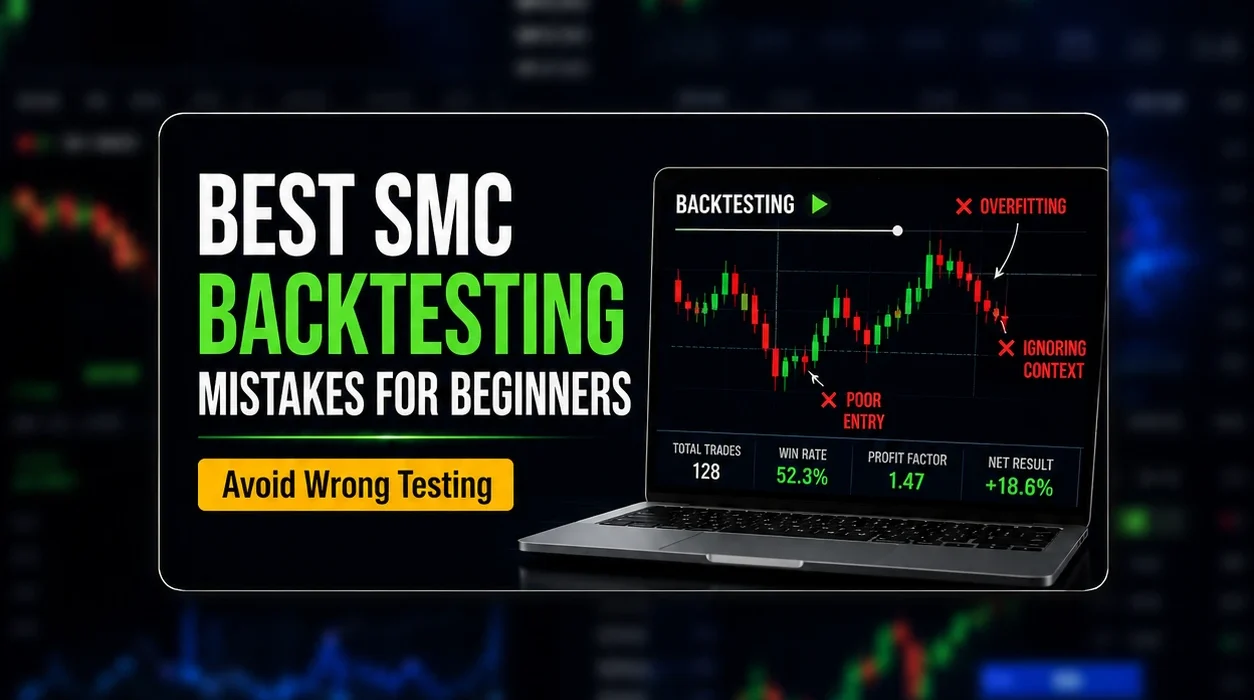
Best SMC Backtesting Mistakes for Beginners is one of the most important topics in Smart Money Concepts because many traders think they are testing a strategy properly when they are actually creating false confidence. A beginner may understand market structure, BOS, CHOCH, liquidity, order blocks, fair value gaps, premium and discount, multi timeframe analysis, entry strategy, risk management, psychology, trading plans, checklists, journaling, and even backtesting basics, but if they make the wrong testing mistakes, the results become misleading.
That is why learning the Best SMC Backtesting Mistakes for Beginners matters so much. A weak backtest can make a bad strategy look good, while a proper backtest shows the real strengths and weaknesses of a setup. Once you understand the Best SMC Backtesting Mistakes for Beginners, your testing becomes more honest, more structured, and much more useful.
What Are the Best SMC Backtesting Mistakes for Beginners
The Best SMC Backtesting Mistakes for Beginners are the common errors traders make while testing Smart Money Concepts setups on historical charts. These mistakes usually come from impatience, unclear rules, hindsight bias, emotional attachment to a setup, or lack of a structured review process.
A typical list of Best SMC Backtesting Mistakes for Beginners includes:
- using hindsight
- changing rules during testing
- testing too few trades
- ignoring losses
- overfitting the setup
- recording poor-quality data
- mixing too many setups together
- focusing only on win rate
These mistakes are dangerous because they create fake confidence. That is why understanding the Best SMC Backtesting Mistakes for Beginners is a major part of becoming a better trader.
Why Best SMC Backtesting Mistakes for Beginners Matter
The Best SMC Backtesting Mistakes for Beginners matters because backtesting is supposed to give clarity, not confusion. If the backtesting process is weak, the trader may believe a setup is profitable when it is not. Then real-money trading becomes frustrating because live results do not match the backtest.
That is why studying the Best SMC Backtesting Mistakes for Beginners helps traders:
- avoid false confidence
- improve testing accuracy
- understand real setup quality
- refine rules more intelligently
- build confidence from data instead of emotion
- reduce the gap between theory and live trading
Without learning the Best SMC Backtesting Mistakes for Beginners, many traders end up trusting numbers that were never reliable in the first place.
Best SMC Backtesting Mistakes for Beginners and Hindsight Bias
One of the biggest Best SMC Backtesting Mistakes for Beginners is hindsight bias. This happens when traders look at a completed chart and say, “This setup was obvious,” because they can already see the outcome. But in real-time trading, that future information was not available.
This is one of the worst Best SMC Backtesting Mistakes for Beginners because it makes weak setups look stronger than they really are. Traders start selecting perfect-looking examples while ignoring the uncertainty that exists before the move happens.
The fix is simple:
- use chart replay
- hide future candles
- make decisions step by step
- record the trade before seeing the outcome
This is one of the most important lessons in the Best SMC Backtesting Mistakes for Beginners because hindsight destroys honest testing.
Best SMC Backtesting Mistakes for Beginners and Unclear Rules
Another major issue in the Best SMC Backtesting Mistakes for Beginners is unclear rules. Many beginners say they are testing “liquidity plus BOS,” but they never define:
- what counts as liquidity
- what counts as a valid BOS
- what makes an order block valid
- where exactly the entry should be
- where the stop loss should go
- where the target should go
This is one of the most damaging Best SMC Backtesting Mistakes for Beginners because unclear rules allow the trader to interpret the setup differently every time. That means the results are not actually repeatable.
A proper fix for the Best SMC Backtesting Mistakes for Beginners is to write exact rules before testing starts and not change them mid-test.
Best SMC Backtesting Mistakes for Beginners and Changing Rules Mid-Test
The Best SMC Backtesting Mistakes for Beginners also includes changing rules while testing. A beginner may start with one entry model, then after a loss decide to add confirmation, then after another loss move the stop placement, then after a win return to the old rule. This makes the whole backtest unreliable.
This is one of the most common Best SMC Backtesting Mistakes for Beginners because traders often do it without realizing it. They think they are improving the setup, but actually they are contaminating the data.
The correct approach in the Best SMC Backtesting Mistakes for Beginners is:
- test one fixed version of the setup
- complete enough trades
- review the results
- only then make changes for the next test cycle
This keeps the backtesting process clean and measurable.
Best SMC Backtesting Mistakes for Beginners and Testing Too Few Trades
One of the biggest Best SMC Backtesting Mistakes for Beginners is using too small a sample size. Many traders test five or ten trades and then conclude that the strategy works or fails. That is not enough data in most cases.
A few wins can create false confidence. A few losses can make a good idea look weak. That is why small sample size is one of the most misleading Best SMC Backtesting Mistakes for Beginners.
A better approach is:
- 20 trades for early insight
- 50 trades for stronger review
- 100 trades for more reliable evidence
This makes the Best SMC Backtesting Mistakes for Beginners much easier to avoid because the strategy is judged over repetition, not emotion.
Best SMC Backtesting Mistakes for Beginners and Mixing Multiple Setups Together
The Best SMC Backtesting Mistakes for Beginners often happens when traders test too many setup models at once. For example, they take some liquidity sweep trades, some FVG trades, some CHOCH reversals, and some order block continuation trades, then put everything into one result sheet.
This is one of the most frustrating Best SMC Backtesting Mistakes for Beginners because the trader cannot tell which setup is actually working. The data becomes mixed and unclear.
The fix is simple:
- test one setup at a time
- name the setup clearly
- track results separately
- compare setup types only after individual testing is complete
This gives much better clarity and avoids one of the major Best SMC Backtesting Mistakes for Beginners.
Best SMC Backtesting Mistakes for Beginners and Overfitting the Strategy
One of the deeper Best SMC Backtesting Mistakes for Beginners is overfitting. Overfitting means adjusting the setup so much to match historical data that it starts looking perfect in the backtest but becomes weak in real market conditions.
For example, a trader may keep adding conditions:
- only trade on one weekday
- only trade after one exact candle pattern
- only trade one narrow session window
- only take the setup if many extra filters are present
This can create a backtest that looks excellent, but the strategy may become too narrow or too artificial. That is why overfitting is one of the most dangerous Best SMC Backtesting Mistakes for Beginners.
The better approach is to keep the setup logical and simple, not endlessly optimized.
Best SMC Backtesting Mistakes for Beginners and Ignoring Market Context
The Best SMC Backtesting Mistakes for Beginners also includes ignoring context. Some traders only mark entries without recording:
- higher timeframe bias
- session timing
- premium or discount location
- whether liquidity had been taken
- whether the market was trending or ranging
This is a major problem because SMC is deeply based on context. Without context, backtesting loses a lot of its value. A setup that works well in trending conditions may fail often in messy range conditions.
That is why one of the most useful lessons in the Best SMC Backtesting Mistakes for Beginners is to record the market environment with every tested trade.
Best SMC Backtesting Mistakes for Beginners and Focusing Only on Win Rate
A very common error in the Best SMC Backtesting Mistakes for Beginners is focusing only on win rate. Beginners often ask, “What is the win rate?” but ignore everything else.
This is dangerous because a setup with a lower win rate can still be profitable if the reward-to-risk is strong. At the same time, a setup with a high win rate may still fail if the losses are too large or the targets are too small.
That is why the Best SMC Backtesting Mistakes for Beginners should include understanding more important metrics such as:
- reward-to-risk
- average winner
- average loser
- drawdown
- losing streak length
- net expectancy
This gives a much more realistic picture than win rate alone.
Best SMC Backtesting Mistakes for Beginners and Bad Stop Loss Logic
The Best SMC Backtesting Mistakes for Beginners also includes poor stop loss placement. If the stop loss is not placed according to a clear and repeatable rule, then the backtest results lose credibility.
Some traders place very tight stops just to make the reward-to-risk look good. Others place very wide stops to avoid losses. Both distort the test.
In the Best SMC Backtesting Mistakes for Beginners, stop loss should be based on:
- structure invalidation
- sweep high or low
- zone invalidation
- confirmation structure point
This keeps the backtest honest and avoids unrealistic results.
Best SMC Backtesting Mistakes for Beginners and Random Take Profit Changes
Another major part of the Best SMC Backtesting Mistakes for Beginners is changing the take profit randomly. A trader may target 1:2 on one trade, previous highs on another, and full higher timeframe liquidity on another, all without a fixed reason.
This creates messy data. That is why one of the strongest rules against the Best SMC Backtesting Mistakes for Beginners is:
- keep take profit logic fixed
- use one model for the full test cycle
- only change targets after a full review
Consistency is what makes the test meaningful.
Best SMC Backtesting Mistakes for Beginners and Not Journaling Properly
The Best SMC Backtesting Mistakes for Beginners becomes worse when traders do not journal properly. Some traders only count wins and losses. Some do not save screenshots. Some do not note why the trade was taken. Some do not record mistakes.
This is a big problem because weak journaling makes it hard to review the strategy honestly. A proper journal for avoiding the Best SMC Backtesting Mistakes for Beginners should include:
- date
- market
- timeframe
- setup type
- entry, stop, target
- result
- screenshot
- notes on context
- lesson learned
This turns the backtest into a real learning process.
Best SMC Backtesting Mistakes for Beginners and Skipping Losing Trades
One of the worst Best SMC Backtesting Mistakes for Beginners is emotionally avoiding bad results. Some traders unconsciously skip losing examples because they want the strategy to look better.
This creates completely unreliable data. A backtest is only useful when both wins and losses are recorded honestly. That is why skipping losing trades is one of the most harmful Best SMC Backtesting Mistakes for Beginners.
The fix is simple:
- record every valid trade
- accept both wins and losses
- test the setup, not your ego
This mindset is essential for honest improvement.
Best SMC Backtesting Mistakes for Beginners and Rushing to Live Trading
The Best SMC Backtesting Mistakes for Beginners also includes moving too quickly from testing to live trading. Some traders test a few charts, see a handful of good results, and immediately start risking money.
This is dangerous because the strategy may not yet be stable enough. The trader may also not have practiced execution enough. A cleaner process after avoiding the Best SMC Backtesting Mistakes for Beginners is:
- backtest first
- review the data
- practice on replay or demo
- then move to small real risk
This creates a smoother learning curve and better discipline.
How to Avoid the Best SMC Backtesting Mistakes for Beginners
A simple way to avoid the Best SMC Backtesting Mistakes for Beginners is to follow this structure:
- Choose one setup only
- Define exact rules before testing
- Use chart replay to avoid hindsight
- Keep entry, stop, and target logic fixed
- Record every valid trade honestly
- Use enough sample size
- Track more than just win rate
- Review context and screenshots
- Refine only after enough data
- Do not rush into live trading
This is one of the best ways to build confidence without falling into the common Best SMC Backtesting Mistakes for Beginners.
Best SMC Backtesting Mistakes for Beginners Conclusion
The Best SMC Backtesting Mistakes for Beginners can quietly destroy a trader’s confidence and accuracy because weak testing creates false beliefs about a strategy. Many traders think their setup has an edge when in reality the backtest was influenced by hindsight, unclear rules, weak sample size, or emotional bias. That is why studying the Best SMC Backtesting Mistakes for Beginners is so important.
The biggest strength of avoiding the Best SMC Backtesting Mistakes for Beginners is honesty. Honest testing leads to stronger confidence, better data, and more realistic expectations. If you truly want to improve in Smart Money Concepts, then learning to avoid the Best SMC Backtesting Mistakes for Beginners is essential because a clean backtest is the foundation of a reliable strategy.
Best SMC Backtesting Mistakes for Beginners FAQs
What are the Best SMC Backtesting Mistakes for Beginners?
The Best SMC Backtesting Mistakes for Beginners include hindsight bias, unclear rules, small sample size, overfitting, bad journaling, and focusing only on win rate.
Why is hindsight bias one of the Best SMC Backtesting Mistakes for Beginners?
Hindsight bias is one of the Best SMC Backtesting Mistakes for Beginners because it makes setups look obvious after the move has already happened, which creates false confidence.
How many trades should I test to avoid the Best SMC Backtesting Mistakes for Beginners?
To reduce the Best SMC Backtesting Mistakes for Beginners, it is better to test at least 20 trades for early insight and ideally 50 to 100 trades for stronger evidence.
Should I track only win rate in backtesting?
No. One of the Best SMC Backtesting Mistakes for Beginners is focusing only on win rate instead of also tracking reward-to-risk, drawdown, and consistency.
How do I avoid the Best SMC Backtesting Mistakes for Beginners?
You can avoid the Best SMC Backtesting Mistakes for Beginners by using fixed rules, chart replay, proper journaling, enough sample size, and honest review of both wins and losses.

A stock market enthusiast with hands-on experience in trading. He writes simple and practical content to help people understand the market better.


